- TypeScript 90.8%
- JavaScript 8.8%
- CSS 0.2%
- HTML 0.2%
| Filename | Latest commit message | Latest commit date |
|---|---|---|
 0ddb79203a * web: sandbox hardening — opaque-origin inner frame, srcdoc-only, frame-ancestors Harden the MCP Apps sandbox isolation model: - The inner (untrusted-widget) iframe is sandboxed WITHOUT `allow-same-origin` (default "allow-scripts allow-forms") and any server-supplied sandbox value has `allow-same-origin` stripped case-insensitively, so the widget runs under an opaque origin and cannot reach the proxy's DOM to bypass its own CSP via the parent realm. - Widget delivery is `srcdoc`-only (no document.write), which respects the opaque origin. - The relay accepts the inner frame's "null" origin with `event.source === inner.contentWindow` as the unforgeable identity check. - sandbox-controller.ts serves the proxy with `Content-Security-Policy: frame-ancestors http://127.0.0.1:* http://localhost:*`; fetch directives are deliberately omitted so a srcdoc iframe's inherited policy container does not override the per-app CSP. Updated the isolation-model comments and the sandbox-controller integration test asserts the frame-ancestors header (and the absence of fetch directives). Closes #1565 Co-Authored-By: Claude Opus 4.8 (1M context) <noreply@anthropic.com> Claude-Session: https://claude.ai/code/session_01BrihGWcrM9JGRyu41nzZYw * web: enforce per-app _meta.ui.csp in the app bridge + surface resource-read failures - createAppBridgeFactory now builds each app's `_meta.ui.csp` host-side via the sandbox-csp library (approveCspSources → buildSandboxCspPolicy) and wraps the untrusted widget HTML with wrapSandboxedHtml so the CSP <meta> is always the first <head> child before the HTML reaches the sandboxed iframe. The approved (post-filter) csp + permissions are echoed back via hostCapabilities.sandbox so the view sees what was granted. The csp is no longer sent inline through sendSandboxResourceReady — it is enforced via the wrapped meta. - A per-app copy of HOST_CAPABILITIES prevents the sandbox echo from mutating the shared constant. - New optional `onResourceError` dep on AppBridgeFactoryDeps routes resource read/post failures to the caller (also always console.error'd) instead of leaving a silent blank frame. Closes #1566 Co-Authored-By: Claude Opus 4.8 (1M context) <noreply@anthropic.com> Claude-Session: https://claude.ai/code/session_01BrihGWcrM9JGRyu41nzZYw * web: full hostContext delivery + live host-context-changed updates - createAppBridgeFactory now seeds the full hostContext via snapshotHostContext(iframe, HOST_AVAILABLE_DISPLAY_MODES): theme, styles (Mantine design tokens), displayMode ("inline"), availableDisplayModes, and containerDimensions — replacing the theme-only seed. The local currentTheme helper is dropped in favor of hostContext.ts. - AppRenderer gains `displayMode` and `containerRef` props and pushes live host-context changes via the SDK's sendHostContextChange (partial host-context-changed notifications), never a hand-maintained snapshot: - theme + styles via a MutationObserver on <html data-mantine-color-scheme>, - containerDimensions via a ResizeObserver on the host container (or the iframe fallback), gated on `initialized`, skipping 0x0 and value-equal repeats, plus a one-shot push on initialize once layout settles, - displayMode whenever the prop changes (Maximize/Restore), gated on init. Adds AppRenderer host-context tests (theme flip incl. resolved styles, displayMode push + init gate, container-dimensions on init and resize, observer teardown) and updates the factory + story mocks for the new hostContext shape and sendHostContextChange method. Closes #1567 Co-Authored-By: Claude Opus 4.8 (1M context) <noreply@anthropic.com> Claude-Session: https://claude.ai/code/session_01BrihGWcrM9JGRyu41nzZYw * web: honor ui/notifications/size-changed and ui/request-display-mode AppRenderer: - New `onSizeChange` prop forwards the view's ui/notifications/size-changed reports (via the bridge `sizechange` event). - New `onRequestDisplayMode` prop backs an `onrequestdisplaymode` bridge handler that returns the mode the host actually applied; with no handler the request is declined by returning the current host-side mode (falling back to inline). AppsScreen: - Adds a host-controlled RendererContainer (measured for containerDimensions) with an inner box sized by the view-reported height (`appHeight`), so host→view container size and view→host size-changed don't couple. - `handleSizeChange` records the reported height (ignored while maximized); `displayMode` is derived from the maximize toggle and pushed to the view; `handleRequestDisplayMode` filters against HOST_AVAILABLE_DISPLAY_MODES (declining e.g. "pip") and maps fullscreen↔inline onto the maximize state. Adds AppRenderer tests (size forwarding, request-display-mode apply/decline/ fallback) and AppsScreen tests (frame sizing on report, no-height ignore, fullscreen/restore/decline via request-display-mode). Story mocks gain sendHostContextChange/addEventListener. Closes #1568 Co-Authored-By: Claude Opus 4.8 (1M context) <noreply@anthropic.com> Claude-Session: https://claude.ai/code/session_01BrihGWcrM9JGRyu41nzZYw * web: honor ui/download-file with confirmation and http(s) allowlist createAppBridgeFactory now advertises the `downloadFile` host capability and attaches an `ondownloadfile` handler: - Requires a host-mediated confirmation (window.confirm) listing the requested file(s); a declined prompt or an empty payload returns isError without acting. - Inline EmbeddedResources (text or base64 blob) are written to disk via the shared downloadBlob object-URL anchor; base64 is decoded via base64ToBytes. - ResourceLinks are opened in a new tab, restricted to http(s) by the shared isHttpUrl allowlist (javascript:/data:/file:/malformed are rejected). - Labels shown in the confirmation are sanitized (control + format chars stripped, length clamped) so a server-supplied filename/URI can't inject newlines or reflow the prompt. - Partial-batch success is surfaced (isError only when nothing downloaded), with skipped items warned. Adds factory tests for the full download surface (text/blob/link, decline, empty, throw, non-http rejection, label sanitization/clamping, partial batch). Closes #1569 Co-Authored-By: Claude Opus 4.8 (1M context) <noreply@anthropic.com> Claude-Session: https://claude.ai/code/session_01BrihGWcrM9JGRyu41nzZYw * web: surface ui/message and app logging in panels below the running app AppRenderer: - New `onMessage` prop backs an `onmessage` bridge handler that surfaces the view's ui/message content and returns the spec-required empty result; with no handler the submission is declined (isError). - New `onLog` prop forwards MCP `notifications/message` log entries via the bridge `loggingmessage` event, honoring the advertised `logging` capability. AppsScreen: - Adds `messages`/`appLogs` state (cleared with the reported height on select/open/close/back via resetAppChannels) and `handleMessage`/`handleLog`. - Renders a "Messages from app" panel (data-testid="apps-messages", reusing ContentViewer) and a default-expanded collapsible "App logs" panel (data-testid="apps-logs", reusing LogLevelBadge) with logger names and a Clear button, both as pinned panels below the running widget. Adds AppRenderer tests (log forward + no-handler no-throw, ui/message route/empty-result/decline) and AppsScreen tests (message log render + empty result + clear-on-close, log panel expand/collapse/clear). Closes #1570 Co-Authored-By: Claude Opus 4.8 (1M context) <noreply@anthropic.com> Claude-Session: https://claude.ai/code/session_01BrihGWcrM9JGRyu41nzZYw * web: stage partial input — replay tool-input-partial before final tool input AppRenderer: - New `partialInputs` prop (ordered fragments), snapshotted into pendingPartials at bridge-build time (read via a ref so prop churn never rebuilds the iframe) and cleared on dispose. flushPending replays them via bridge.sendToolInputPartial BEFORE the complete tool-input, per spec. AppsScreen: - New `partialStages` state + `handleStagePartialInput` (snapshots current form values). resetAppChannels gains a `keepPartials` option so Open App preserves the staged fragments (they're consumed by the renderer) while select/close/ back clear them. - Adds a "Stage partial input" control (fielded apps only) with a staged count and "Clear staged", wired to AppRenderer's `partialInputs`. Adds AppRenderer tests (ordered replay before tool-input; none when omitted) and AppsScreen tests (stage/count/clear gated on fields; staged partials survive Open and are replayed). Closes #1571 Co-Authored-By: Claude Opus 4.8 (1M context) <noreply@anthropic.com> Claude-Session: https://claude.ai/code/session_01BrihGWcrM9JGRyu41nzZYw * web: app lifecycle status + machine-readable data attributes on the Apps screen AppRenderer: - New AppRendererStatus ("loading" | "ready" | "error") + onAppStatusChange callback. Fires "loading" at the start of every (re)build, "ready" on the view's initialized signal, and "error" on a factory throw/rejection. AppsScreen: - appStatus/appError state; handleAppError captures the reason locally and forwards to the parent onError. resetAppChannels clears both. - Surfaces the contract as data-testid="apps-form" carrying data-app-status and data-app-error, renders an error panel (data-testid="apps-error") in place of the blank frame, and tags the stage button data-testid="apps-stage". - AppDetailPanel's Open App button gains data-testid="open-app". App.tsx: - Wires the bridge factory's onResourceError to a red toast so a malformed/404 UI resource is no longer console-only (the renderer separately drives data-app-status, so a driver times out on never-reaching-ready and reads it). Documents the data-testid/data-* automation contract in clients/web/README.md. Adds AppRenderer status-transition tests and AppsScreen status/error-panel tests. Closes #1572 Co-Authored-By: Claude Opus 4.8 (1M context) <noreply@anthropic.com> Claude-Session: https://claude.ai/code/session_01BrihGWcrM9JGRyu41nzZYw * review: warn when server sandbox drops allow-scripts + revert incidental lockfile churn Addresses the claude[bot] review on PR #1650: - sandbox_proxy.html: log a console.warn when a server-supplied `sandbox` value lacks `allow-scripts` after the `allow-same-origin` strip, so a fail-closed (app-never-runs) sandbox is diagnosable instead of silent. - Restore clients/{cli,launcher,tui,web}/package-lock.json to their v2/main state — the earlier churn (@emnapi/@napi-rs optional deps, a dropped version field) was incidental `npm install` regeneration unrelated to the sandbox change. Co-Authored-By: Claude Opus 4.8 (1M context) <noreply@anthropic.com> Claude-Session: https://claude.ai/code/session_01BrihGWcrM9JGRyu41nzZYw * review: document CSP-vs-permissions filtering asymmetry (PR #1652) Address the claude[bot] review's finding #2: add a comment explaining why `csp` is injection-filtered (approveCspSources) while `permissions` is passed through verbatim — permissions is a structured boolean object consumed only by the sandbox proxy's buildAllowAttribute() (fixed key→token mapping), so it never reaches the iframe sandbox/allow attribute as raw text. No logic change. Also merges v2/1565-sandbox-hardening (review fixes) up the stack. Co-Authored-By: Claude Opus 4.8 (1M context) <noreply@anthropic.com> Claude-Session: https://claude.ai/code/session_01BrihGWcrM9JGRyu41nzZYw * test: lock in per-app HOST_CAPABILITIES isolation (PR #1652 round 2) Add a test asserting the shared HOST_CAPABILITIES.sandbox stays undefined after a sandboxready run sets hostCapabilities.sandbox — guards against a silent regression if the per-app spread copy were ever dropped. Co-Authored-By: Claude Opus 4.8 (1M context) <noreply@anthropic.com> Claude-Session: https://claude.ai/code/session_01BrihGWcrM9JGRyu41nzZYw * review: gate theme observer on initialized + document seed/dep assumptions (PR #1654) Address the claude[bot] review: - Finding #1 (applied): gate the theme+styles MutationObserver on the view's `initialized` signal, matching the container/displayMode pushes — a theme flip in the construction→handshake window no longer races ui/initialize. The factory seeds the construction-time theme, and the first post-init flip carries the current value. Added tests: pre-init flip is dropped; the live flip test now completes the handshake first. - Finding #2 (applied, comment): note in snapshotHostContext that the `displayMode: "inline"` seed assumes inline-at-open (AppsScreen always opens inline; #1568's displayMode push carries transitions). - Finding #4 (applied, comment): explain why `containerRef` is a build-effect dep yet doesn't force a rebuild (sameInputs ignores it; read lazily). Co-Authored-By: Claude Opus 4.8 (1M context) <noreply@anthropic.com> Claude-Session: https://claude.ai/code/session_01BrihGWcrM9JGRyu41nzZYw * review: guard 0-height size reports, distinct RendererFrame, shared payload type (PR #1656) Address the claude[bot] review: - #1 (applied): handleSizeChange ignores a non-positive height — a view's ResizeObserver can transiently fire 0 pre-layout/teardown, which would collapse the frame; mirrors AppRenderer's 0×0 skip. Added a test. - #2 (applied): reinstate a distinct `RendererFrame` constant for the inner content-sized box so its role reads clearly vs. the outer RendererContainer. - #3 (declined + comment): keep carrying `appHeight` across maximize→restore — clearing it would flash the frame to full-card height until the next size-changed; the carry-over restores at the prior size. Documented. - #4 (applied): type handleSizeChange's param as AppBridgeEventMap["sizechange"] so the payload shape has a single source of truth with AppRenderer's prop. Co-Authored-By: Claude Opus 4.8 (1M context) <noreply@anthropic.com> Claude-Session: https://claude.ai/code/session_01BrihGWcrM9JGRyu41nzZYw * review: distinguish links, cap batch size, comment truncation (PR #1657) Address the claude[bot] review: - #1 (applied): the confirmation now reads "download or open N item(s)" and resource_links are prefixed "↗" in the summary, so a link that opens in a tab is distinguishable from an embedded file that saves to disk. - #2 (applied): cap a single ui/download-file batch at MAX_DOWNLOAD_ITEMS (20); an oversized batch is rejected (isError) before the prompt, with a warn. - #3 (declined): can't check window.open's return value to detect a blocked popup — we pass `noopener`, and per spec window.open returns null even on a successful noopener open, so null can't distinguish blocked from succeeded. - #4b (applied, comment): note the start-of-label truncation is intentional so a link's scheme+host stays visible for the trust decision. Adds tests: oversized batch rejected without confirming/acting; resource-link ↗ prefix in the summary. Co-Authored-By: Claude Opus 4.8 (1M context) <noreply@anthropic.com> Claude-Session: https://claude.ai/code/session_01BrihGWcrM9JGRyu41nzZYw * review: skip embedded resource with neither text nor blob (PR #1657 round 2) Address the round-2 observation: an untrusted EmbeddedResource carrying neither `blob` nor a string `text` previously produced `new Blob([undefined])` — a file containing the literal text "undefined", counted as success. Now such an item is skipped (returns false, like a rejected link), so isError reflects it. Added a test asserting no object URL is created and the batch reports isError. Co-Authored-By: Claude Opus 4.8 (1M context) <noreply@anthropic.com> Claude-Session: https://claude.ai/code/session_01BrihGWcrM9JGRyu41nzZYw * review: type-honest formatLogData, cap channels, log-panel a11y (PR #1658) Address the claude[bot] review: - #1 (applied): formatLogData coalesces JSON.stringify(undefined) → "" so the `: string` return type is honest for a data-less log. - #2 (applied): cap retained messages/logs at MAX_APP_CHANNEL_ENTRIES (500) via appendCapped — a chatty widget no longer grows the panels/DOM without bound between Clear/close; oldest entries drop. - #3 (declined): keep the Messages panel without a Clear/collapse — messages are sparser and already cleared on close/switch; keeping it simple. - #4 (applied): the App-logs toggle now has aria-controls pointing at the Collapse region (id="apps-logs-region") for assistive tech. Adds tests: no-data log renders (coalesce branch), 501 logs cap at 500 (oldest dropped), aria-controls assertion. Co-Authored-By: Claude Opus 4.8 (1M context) <noreply@anthropic.com> Claude-Session: https://claude.ai/code/session_01BrihGWcrM9JGRyu41nzZYw * review: stable id key for Messages panel (PR #1658 round 2) Address the round-2 nit: give AppMessage a stable `id` (assigned via nextMessageIdRef in handleMessage) and key the Messages panel on it instead of the array index — so the appendCapped front-drop can't renumber keys once a run exceeds the cap, matching AppLogEntry's treatment. Co-Authored-By: Claude Opus 4.8 (1M context) <noreply@anthropic.com> Claude-Session: https://claude.ai/code/session_01BrihGWcrM9JGRyu41nzZYw * review: note partialStages intentionally survives handleOpen (PR #1659) Address the claude[bot] review's observation #2: add a comment at the handleOpen call site clarifying that partialStages is intentionally NOT cleared there — AppRenderer snapshots the fragments into its own pendingPartialsRef at build time, and the staging UI only renders while not running, so the surviving state is invisible until the next reset drains it. Co-Authored-By: Claude Opus 4.8 (1M context) <noreply@anthropic.com> Claude-Session: https://claude.ai/code/session_01BrihGWcrM9JGRyu41nzZYw * review: align error-panel docs with behavior + gate data-app-error on running (PR #1660) Address the claude[bot] review: - #1 (applied, docs): the error panel renders BELOW the (blank) frame, not in place of it — the renderer stays mounted so a factory error still shows the reason alongside the iframe (gating the frame off on error would drop the auto-launched iframe an integration test relies on). Reworded the README row and the test comment to say "below the frame"; added a code comment. - #2 (applied): gate data-app-error on `running` (like data-app-status) so the two attributes can't desync if a future path sets an error without running. - #3 (no change): resource-read failures staying at data-app-status="loading" (toast only) is intentional and documented. Co-Authored-By: Claude Opus 4.8 (1M context) <noreply@anthropic.com> Claude-Session: https://claude.ai/code/session_01BrihGWcrM9JGRyu41nzZYw --------- Co-authored-by: Claude Opus 4.8 (1M context) <noreply@anthropic.com> |
||
| .claude | ||
| .github/workflows | ||
| clients | ||
| core | ||
| scripts | ||
| specification | ||
| test-servers | ||
| .dockerignore | ||
| .gitignore | ||
| .npmignore | ||
| AGENTS.md | ||
| CLAUDE.md | ||
| Dockerfile | ||
| package-lock.json | ||
| package.json | ||
| README.md | ||
| tsconfig.base.json | ||
| vitest.shared.mts | ||
MCP Inspector
A developer tool for inspecting Model Context Protocol (MCP) servers. It ships as a single package, @modelcontextprotocol/inspector, that provides three ways to inspect a server:
- Web — a Vite + React + Mantine single-page app with a Node backend.
- CLI — a scriptable command-line client for automation, CI, and fast agent feedback loops.
- TUI — an interactive terminal UI built with Ink.
All three run through one global mcp-inspector binary:
npx @modelcontextprotocol/inspector          # web UI (default)
npx @modelcontextprotocol/inspector --cli    # CLI
npx @modelcontextprotocol/inspector --tui    # TUI
Repo status. This is the v2 line of the Inspector (branch
v2/main). Themainbranch is the legacy v1 implementation (bug fixes only). v2 will eventually replacemain. SeeAGENTS.mdfor branch/board conventions.
Project layout
v2 is not an npm workspace. Each client under clients/* keeps its own package.json and node_modules; shared code lives in core/ and is consumed via a @inspector/core build-time alias (no package.json of its own). A single npm install at the root cascades installs into every client (see Setup).
inspector/
├── clients/
│   ├── web/          # Web client (Vite + React + Mantine). src/ = browser app; server/ = Node dev/prod backend
│   ├── cli/          # CLI client (tsup bundle, @inspector/core alias)
│   ├── tui/          # TUI client (Ink + React, tsup bundle)
│   └── launcher/     # Shared launcher — provides the `mcp-inspector` bin, dispatches to web/cli/tui
├── core/             # Shared code consumed via the `@inspector/core` alias (no package.json)
│   ├── auth/         # OAuth: providers, discovery, storage, mid-session recovery (browser/node/remote backends)
│   ├── json/         # JSON + parameter/argument conversion utilities
│   ├── logging/      # Silent pino logger singleton
│   ├── mcp/          # InspectorClient runtime, state stores, transports, config import
│   ├── react/        # React hooks over the state stores
│   └── storage/      # File I/O helpers for the OAuth persist backends
├── test-servers/     # Composable MCP test servers + fixtures used by integration tests
├── scripts/          # Root build/verify tooling (install cascade, smokes, pack:verify)
├── specification/    # Design/build specifications
├── AGENTS.md         # Contribution rules for agents AND humans (see below)
└── README.md         # You are here
Each client has its own README with client-specific detail: web · cli · tui · launcher.
Setup
Requires Node >=22.19.0.
npm install # root install; postinstall cascades into every client
- Fresh clone: run
npm installat the repo root. - After a pull that changes a client's dependencies: re-run
npm installat the root to re-sync every client.
The cascade (scripts/install-clients.mjs) is dev-only — it exits early when the package is installed as a dependency, and the published tarball ships only each client's build/, so end users are unaffected. Set INSPECTOR_SKIP_CLIENT_INSTALL=1 to skip it.
Running during development
For day-to-day web iteration, run Vite directly from the web client (fast HMR, no launcher build needed):
cd clients/web && npm run dev
The launcher-driven scripts below run the built launcher, so build first (npm run build):
npm run web        # prod web launcher against clients/web/dist
npm run web:dev    # web launcher in --dev mode (Vite)
The @inspector/core shared package
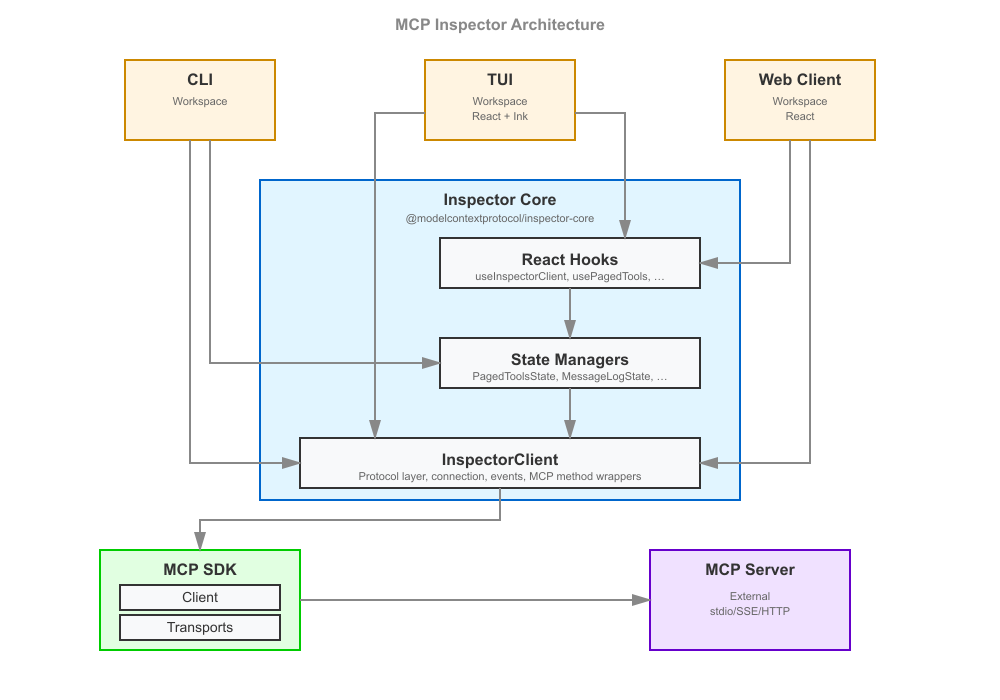
core/ holds the logic shared by all three clients so that web, CLI, and TUI behave identically. Its entry point is the InspectorClient class (core/mcp/), which owns the connection to an MCP server, the request/response lifecycle, and a set of state stores; core/react/ exposes React hooks over those stores that both the web and TUI (Ink) React trees consume. OAuth (core/auth/) is factored into isomorphic logic plus browser/node/remote backends so the same flows work in the browser, in Node, and against a remote backend.
core/ intentionally has no package.json — it is not published on its own. Each client bundles it in via a @inspector/core alias:
- CLI / TUI:
esbuildOptions.aliasin theirtsup.config.tsmaps@inspector/core→ the repocore/directory, andnoExternal: [/^@inspector\/core/]inlines it into the bundle. - Web: the same alias in
clients/web/vite.config.tsfor the browser app and the Node backend runner.
Publishing core/ as its own package (e.g. for third parties to build on) is deliberately deferred — see issue #1636.
Web client: "dumb components" + Storybook
The v2 web client is built from presentational ("dumb") components — they accept data and callbacks as props and contain only display logic, with no direct data fetching or client state. State comes from the @inspector/core hooks, wired in near the top of the tree. This keeps components isolated, testable, and documentable.
That approach is what makes Storybook first-class here: every screen and element component has a *.stories.tsx file (96+ stories) that renders it against fixture props. Storybook play functions double as interaction tests, run headless in CI (npm run ci:storybook, Chromium via Playwright).
Styling follows a strict Mantine-first convention (theme variants and component props over CSS classes, --inspector-* CSS custom properties over raw color literals). The full rules live in AGENTS.md under React instructions — read them before touching web UI. Element components live in clients/web/src/components/elements/; theme variants in clients/web/src/theme/.
Test servers
test-servers/ provides composable MCP servers used by the integration and smoke suites, so tests exercise a real server over a real transport instead of mocks. A server is assembled from presets (fixture factories in test-servers/src/preset-registry.ts — tools, resources, prompts, tasks, elicitation, sampling, OAuth, …) and can be driven two ways:
- In-process — import the factories (
createTestServerHttp,createEchoTool, …) and run the server inside the test's event loop (used by the HTTP integration paths). - As a subprocess —
test-servers/build/test-server-stdio.jsis spawned as a real stdio child (used by the CLI smoke and stdio integration tests).
Configure a server declaratively with a JSON config (see test-servers/configs/*.json) selecting presets, then load it via --config. Because the servers are spawned as real subprocesses, the build output must exist first:
npm run test-servers:build # (from clients/web) → tsc -p test-servers, emits test-servers/build/
The Vite alias @modelcontextprotocol/inspector-test-server (in clients/web/vite.config.ts) points at test-servers/build/index.js so getTestMcpServerPath() resolves to a real .js path.
Building
npm run build # builds all clients: web → cli → tui → launcher
Individual clients: build:web, build:cli, build:tui, build:launcher. The web build produces both the browser SPA (clients/web/dist, Vite) and the Node prod-server runner (clients/web/build, tsup).
Testing & the quality gate
Each client self-validates from its own folder; the root scripts chain them. There is no aggregate root test script — use validate (fast) or coverage (the gate).
| Script | What it does |
|---|---|
npm run validate |
format:check + lint + build + fast unit tests, per client. The quick inner-loop check. |
npm run coverage |
The per-file ≥90% gate (lines/statements/functions/branches) under v8 instrumentation, per client. CI-enforced. For web this also runs the integration project. |
npm run smoke |
End-to-end smokes through the built launcher (--help dispatch + prod cli/tui/web). |
npm run ci |
Mandatory pre-push command. validate → coverage → smoke → Storybook. A true superset of GitHub CI. |
npm run pack:verify |
Publish smoke — see Publishing. |
Per-client scripts exist too (validate:web, coverage:cli, smoke:tui, …). Run npm run format (per client) before committing — validate runs the non-fixing format:check and fails CI on any unformatted file.
For the full testing rules — the ≥90% per-file gate, where test files live, the unit vs. integration vs. storybook projects, and the v8 ignore policy — see AGENTS.md.
Publishing
The root @modelcontextprotocol/inspector package ships as one tarball with a single version number — no separate -web / -cli / -tui / -core packages. npm run build builds every client, then prepack runs before npm publish. Runtime dependencies are declared on the root package.json; client builds bundle @inspector/core and externalize npm packages resolved from the root install.
What ships, and the packaging invariants
The root package.json "files" allowlist is the source of truth for the tarball. A few non-obvious entries exist because they are read at runtime or were silently dropped by npm's packlist — do not remove them without re-running npm run pack:verify:
- No source maps. The client bundlers set
sourcemap: false(clients/{cli,tui}/tsup.config.ts,clients/web/tsup.runner.config.ts); Vite and the launcher'stscalready emit none. Maps are ~half the unpacked size and aren't needed at runtime — debug vianpm run devon the source. clients/web/buildships viaclients/web/.npmignore.clients/web/.gitignorelistsbuild/, and npm's packlist honors that nested.gitignoreover the root"files"allowlist — so the prod web-server runner was silently missing from the tarball whileclients/web/distslipped through (its.gitignoreonly listsdist-ssr).clients/web/.npmignoreoverrides the.gitignorefor publishing so bothbuild/(runner) anddist/(SPA) ship. The other clients don't need this — none ship a nested.gitignore.- A single version number, read from the root
package.json. The Inspector ships as one package with one version, so only the rootpackage.jsoncarries aversion— the fourclients/*/package.jsons deliberately have none. Every Node client (CLI, TUI, and the web backend) resolves the version through the sharedreadInspectorVersion()reader incore/node/version.ts, which walks up to the root manifest (always present in the tarball). No clientpackage.jsonis read at runtime, so none needs to ship. The web browser can't read the filesystem; it gets its version from the backend viaGET /api/config(see #1639).
npm run pack:verify — publish smoke against the real tarball
The smoke:* scripts run against the in-repo build tree, which is not the published package. npm run pack:verify (scripts/pack-and-verify.mjs) closes that gap: it builds, npm packs the publishable tarball (asserting no source maps ship and that the runtime-required files are present), installs the tarball into a clean throwaway consumer — a fresh temp directory where it runs a real npm install <tgz> (pulls runtime deps, runs postinstall), exactly as npx @modelcontextprotocol/inspector would — and drives the installed mcp-inspector bin end to end: --help dispatch, a real --cli tools/list over stdio, and a prod --web boot that must serve / from the shipped dist. It catches "works in --dev, breaks under npx …" path/packaging failures. It requires network access (the install pulls deps), so it is a local / release check, not part of the fast validate/ci loop.
Cutting a release
Publishing is automated by two release-gated jobs in .github/workflows/main.yml (github.event_name == 'release', both needs: build):
publish— the npm package. Runsnpm run pack:verifyas the pre-publish gate, asserts the release tag matches the rootpackage.jsonversion, thennpm publish --access public --provenance— a singlenpm publish(v2 is not an npm workspace, so there is no v1-stylepublish-all/--workspaces), with a signed provenance attestation via GitHub OIDC (id-token: write,environment: release,NPM_TOKEN).publish-github-container-registry— the container image (see Docker).
Because there is one version number (only the root package.json has one — the clients carry none, so there is nothing to keep in sync and no check-version step), the release flow is just:
npm version <major|minor|patch>   # bumps the root package.json + tags
git push --follow-tags
# then draft & publish a GitHub Release for that tag → triggers `publish`
The release's target commit selects which workflow runs, so this only publishes when a release is cut from a commit carrying this (v2) workflow.
Docker
A container image is published to GHCR (ghcr.io/modelcontextprotocol/inspector, linux/amd64 + linux/arm64) by the release workflow. The Dockerfile is a two-stage build: the first stage installs and npm packs the publishable tarball; the second stage npm install -gs that tarball, so the image ships the exact same artifact as npm, with a clean mcp-inspector bin.
# run the web UI (reads the auth token from the container logs)
docker run --rm -p 6274:6274 ghcr.io/modelcontextprotocol/inspector

# or build the image locally
docker build -t mcp-inspector .
docker run --rm -p 6274:6274 mcp-inspector
The image defaults to --web bound to 0.0.0.0:6274 with browser auto-open disabled; override the args to run another mode (docker run --rm ghcr.io/modelcontextprotocol/inspector --cli …). Pass -e MCP_INSPECTOR_API_TOKEN=… to set a known token (otherwise one is generated and printed in the logs), or -e DANGEROUSLY_OMIT_AUTH=true to disable auth. The image runs as the non-root node user and has a HEALTHCHECK that probes the web UI — it assumes the default --web mode, so add --no-healthcheck when running --cli/--tui (which have no web server).
Contributing — AGENTS.md and CLAUDE.md
AGENTS.md is the contract for changing this codebase, and it applies to humans and AI agents alike. It is not agent-only boilerplate — it holds the project's real conventions: the issue-and-board workflow, branch/label rules, the TypeScript and Mantine/React standards, the testing and coverage requirements, and the mandatory pre-push gate. Read it before making changes, and keep it up to date when you change structure, tooling, or rules.
CLAUDE.md is the entry point the Claude Code agent loads automatically; it simply includes AGENTS.md and this README, so both agents and humans work from the same source of truth. If you use a different agent that reads AGENTS.md, you get the same rules.
A key rule worth surfacing here: all work is issue-driven. Before starting, find or create a tracking issue on the v2 project board; open PRs against v2/main with Closes #<issue>. The exact recipes (labels, board IDs, statuses) are in AGENTS.md.
License
MIT.