| Filename | Latest commit message | Latest commit date |
|---|---|---|
 23e0c39d11 GHSA-p63j-vcc4-9vmv (**critical**) — `@vitest/browser` Browser Mode provider commands accept a file path from the browser and act on it without checking the `allowWrite` permission gate. Patched in 4.1.10; `clients/web` was pinned at 4.1.0. Dev-scope only — `@vitest/*` is absent from the published `files` allowlist, and Browser Mode here runs this project's own Storybook play functions, never a third-party page. That is why #1837 deferred it rather than attempting a toolchain upgrade immediately before an irreversible publish. ## The knot, and what actually unties it `^4.1.0` already admits 4.1.10, so the declared ranges were never the problem. The family is welded by *exact* peer pins — `vitest` pins `@vitest/browser-playwright`, which pins `@vitest/browser` — so nothing moves alone. The issue predicted that an explicit coordinated `npm i -D` would fix it. It does not. With `clients/web/package-lock.json` in place, npm ERESOLVEs even when every member of the family plus the Storybook packages are named in one command and `node_modules` is deleted first: Found: @storybook/addon-a11y@10.2.19 Could not resolve dependency: dev @storybook/addon-a11y@"^10.5.5" Conflicting peer dependency: storybook@10.5.5 npm resolves against the existing lock tree and will not move the whole constellation at once. **Regenerating `clients/web/package-lock.json` is the only thing that unties it** — a clean resolve places all four at 4.1.10 with no peer complaints at all. ## Versions vitest 4.1.0 -> 4.1.10 @vitest/browser 4.1.0 -> 4.1.10 (transitive) @vitest/browser-playwright 4.1.0 -> 4.1.10 @vitest/coverage-v8 4.1.0 -> 4.1.10 storybook + @storybook/* 10.2.19 -> 10.5.5 eslint-plugin-storybook 10.2.19 -> 10.5.5 @chromatic-com/storybook 5.0.1 -> 5.2.1 `clients/{cli,tui,launcher}` were already resolving 4.1.9 (no browser pins, so they floated freely) and were never vulnerable. Their declared `^4.1.0` still *permitted* 4.1.0 on a fresh resolve, so the floor is raised to `^4.1.10` in all four manifests — same reasoning as the vite floor in #1841. Pinning only the lockfile would have left a regression path open. ## The vite 8 peer override Resolved, as a consequence rather than a workaround. `@joshwooding/vite-plugin-react-docgen-typescript@0.6.4` declared `peer vite@"^3 || ^4 || ^5 || ^6 || ^7"` against our vite 8. It is not a direct dependency — it arrives through `@storybook/react-vite`, which at 10.5.5 depends on `^0.7.0`, and 0.7.0 adds `^8.0.0` to that range. So taking Storybook 10.5.5 for the peer set drops the override too; nothing is forced. ## Two holds the regeneration forced, each with a tracked issue Regenerating the lock floats every other in-range dependency to current. Most of that is welcome — it is what takes `clients/web` from 19 advisories to 1 — but two floats broke the gate and are unrelated to this security fix: - **zod 4.3.6 -> 4.4.3** makes `clients/web`'s `tsc -b` die with `FATAL ERROR: Ineffective mark-compacts near heap limit` at the ~4GB default. Reverting zod alone makes it exit 0, so the attribution is unambiguous. Held at `~4.3.6`. See #1896. - **eslint-plugin-react-hooks 7.0.1 -> 7.1.1** enables `set-state-in-effect`, which fails `lint` on 8 pre-existing violations across 7 components. Fixing them is a real refactor with interaction-behavior consequences, not a suppression. Held at `~7.0.1`. See #1897. Both `~` pins are deliberate and temporary, and both issues say so — they are constraints to remove, not preferences. Storybook 10.5.5 also reports that `setProjectAnnotations` is applied automatically since 10.3, making `.storybook/vitest.setup.ts` redundant. Left in place: `./preview` carries the Mantine decorator and the a11y annotations drive the play-function assertions, and if automatic provisioning missed either, the 462 stories would render unthemed with a11y checks inert and very likely still pass. That silent-failure risk does not belong in a security bump. See #1898. ## Audit delta `clients/web`, where the advisory lived: before 19 (4 critical, 6 high, 6 moderate, 3 low) after 1 (1 low — esbuild-in-tsup, Windows dev server only) All four critical entries — `vitest`, `@vitest/browser`, `@vitest/browser-playwright`, `@vitest/coverage-v8` — are gone. The other 14 are transitive dev-tree advisories (hono, ws, js-yaml, flatted, brace-expansion, ...) cleared as a side effect of the clean resolve. Elsewhere: cli 6 -> 5, launcher 3 -> 2, tui 4 -> 4, root unchanged at 9 (its lock is untouched). Those remainders are pre-existing and unrelated. ## Verification `npm run ci` green end to end on the upgraded stack — the point of caring here, since this *is* the test infrastructure: - coverage gate (>=90 per file, all four dimensions) passes on all four clients; no file regressed, so no gate was lowered and no `v8 ignore` added - 4802 web tests, 304 cli, 282 tui, 5 launcher - 462 Storybook play functions across 109 files, on vitest 4.1.10 Browser Mode - verify:build-gate, and all five smokes including `smoke:tui` (real TTY here) Claude-Session: https://claude.ai/code/session_01YAt8rqxysNbhYWLhoRm3fU Co-authored-by: Claude Opus 5 (1M context) <noreply@anthropic.com> |
||
| .. | ||
| __tests__ | ||
| src | ||
| dev.ts | ||
| eslint.config.js | ||
| index.ts | ||
| package-lock.json | ||
| package.json | ||
| README.md | ||
| test-config.json | ||
| tsconfig.json | ||
| tsconfig.test.json | ||
| tsup.config.ts | ||
| tui.tsx | ||
| vitest.config.ts | ||
MCP Inspector TUI Client
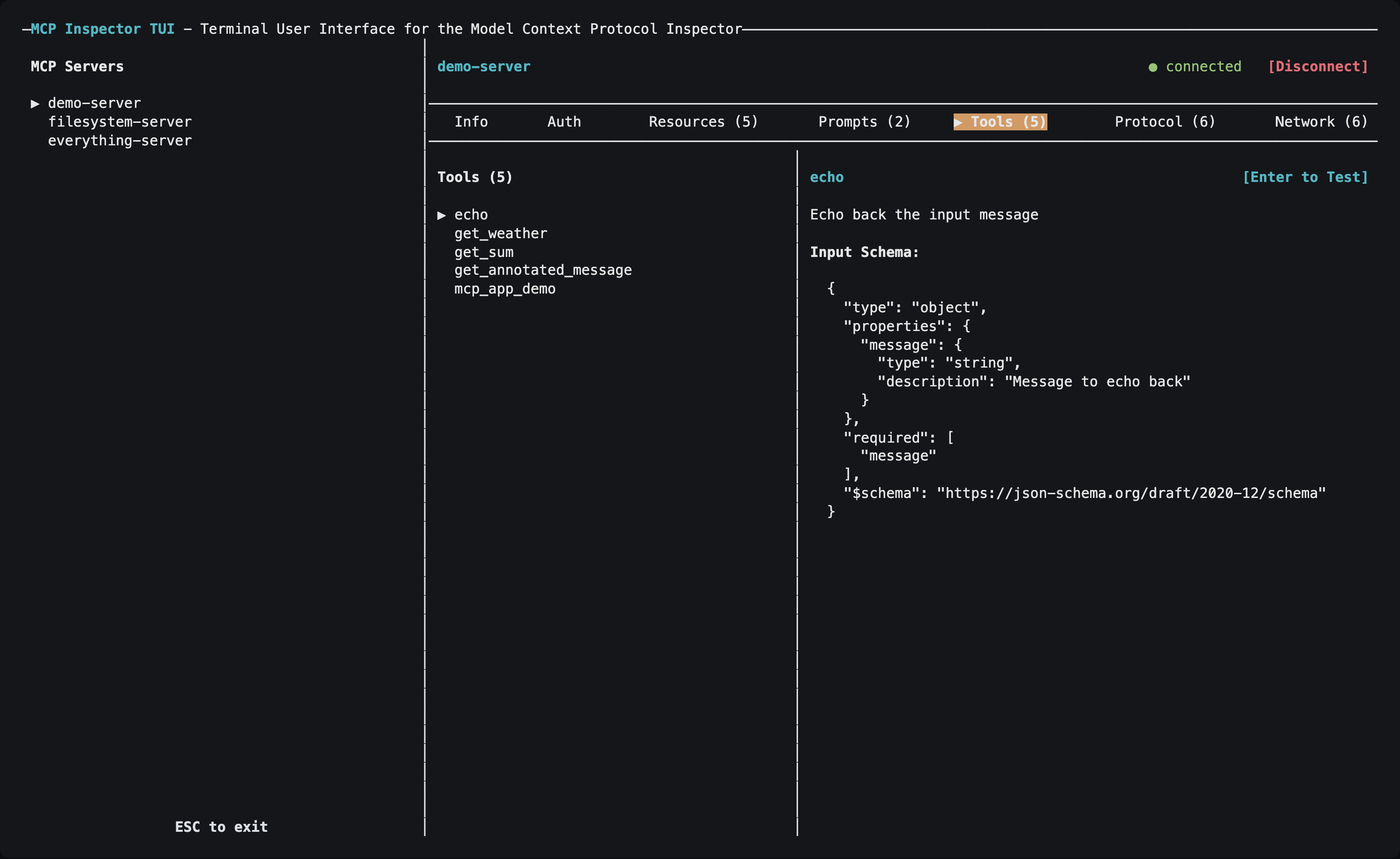
The Terminal User Interface (TUI) client brings the interactive exploration capabilities of the Web Client directly to your terminal. It is built using Ink to provide a rich, React-like component experience in a command-line environment.
Running the TUI
You can run the TUI client via npx:
npx @modelcontextprotocol/inspector --tui node build/index.js
With Configuration Files
The TUI can load all servers from an MCP catalog/config file. With no source
flag it uses the default writable catalog ~/.mcp-inspector/mcp.json (seeded
empty if missing):
npx @modelcontextprotocol/inspector --tui --catalog mcp.json   # writable catalog (seeded empty if missing)
npx @modelcontextprotocol/inspector --tui --config mcp.json    # read-only session (errors if absent)
(It does not use --server; all servers in the file are available in the TUI.)
Options
MCP server (which server(s) to connect to)
Options that specify the MCP server(s) (catalog/config file, ad-hoc command/URL, env vars, headers) are shared by the Web, CLI, and TUI and are documented in MCP server configuration: --catalog (writable catalog, seeded empty if missing; default ~/.mcp-inspector/mcp.json or MCP_CATALOG_PATH), --config (read-only session, errors if absent), -e, --cwd, --header, --transport, --server-url, and the positional [target...]. --catalog and --config are mutually exclusive, and neither combines with an ad-hoc target.
TUI-specific (OAuth for HTTP servers)
The TUI supports OAuth for SSE and Streamable HTTP servers. Per-server OAuth fields in mcp.json (static client id/secret, scopes, enterprise-managed flag) are applied automatically when loaded from --catalog or --config. Install-wide settings (CIMD, enterprise IdP) come from ~/.mcp-inspector/storage/client.json — the same file the web Client Settings dialog writes. You can point at a different file with --client-config or MCP_CLIENT_CONFIG_PATH.
OAuth callback URL
The TUI starts a small loopback HTTP server to receive the authorization redirect after you sign in in the browser. Defaults:
| Surface | Default callback |
|---|---|
| Web | http://localhost:6274/oauth/callback (main app server) |
| TUI | http://127.0.0.1:6276/oauth/callback (dedicated runner port; avoids colliding with web on 6274) |
Why a fixed default port? Enterprise-managed auth (EMA), CIMD, and many static OAuth apps require pre-registered redirect URIs. A predictable default (http://127.0.0.1:6276/oauth/callback) lets you register once on the IdP and reuse it across TUI sessions. Dynamic registration (DCR) can use ephemeral ports instead — see below.
Trade-off: only one TUI OAuth flow at a time can listen on the default port. A second instance starting OAuth while another is in progress may fail with EADDRINUSE. Override the listener with --callback-url or MCP_OAUTH_CALLBACK_URL (e.g. a different fixed port per instance, or http://127.0.0.1:0/oauth/callback when the authorization server accepts dynamically registered redirect URIs).
OAuth redirect URIs must match exactly what you register on the authorization server — localhost and 127.0.0.1 are different URIs. Register the TUI default on your OAuth app / IdP when using pre-registered (static), CIMD, or enterprise-managed clients. Override the listener with --callback-url or MCP_OAUTH_CALLBACK_URL; use http://127.0.0.1:0/oauth/callback for an OS-assigned ephemeral port when the authorization server registers redirect URIs dynamically (DCR).
Flags
| Option | Env | Description |
|---|---|---|
--client-config <path> |
MCP_CLIENT_CONFIG_PATH |
Install-level client config (default: ~/.mcp-inspector/storage/client.json). |
--client-id <id> |
— | OAuth client ID (static client); overrides client.json. |
--client-secret <secret> |
— | OAuth client secret (confidential clients); overrides client.json. |
--client-metadata-url <url> |
— | Client ID Metadata Document URL (CIMD); overrides client.json. |
--callback-url <url> |
MCP_OAUTH_CALLBACK_URL |
OAuth redirect/callback listener (default: http://127.0.0.1:6276/oauth/callback). Must bind a loopback host (localhost / 127.0.0.0/8 / [::1]); a non-loopback host hard-errors, since the listener receives the authorization code over plaintext http. |
Authenticating in the TUI
- Select an HTTP/SSE server and press C to connect.
- If authorization is required, the TUI starts OAuth automatically (browser opens for sign-in).
- After the callback completes, connect finishes without a second C.
- Use the Auth tab to inspect OAuth state (same fields as web Connection Info) or Clear OAuth state (disconnects when connected).
See also EMA / enterprise-managed auth and OAuth smoke testing for staging servers and verification steps.
Features
The TUI provides terminal-native tabs and panes for interacting with your MCP server:
- Resources: Browse and read resources exposed by the server.
- Prompts: List and test prompts.
- Tools: View available tools and execute them with form-like inputs.
- Protocol: View JSON-RPC request/response/notification history (matches the web Protocol monitor).
- Network: View HTTP fetch traffic for SSE / Streamable HTTP servers (matches the web Network monitor).
- Console: View stdio stderr from the connected server process (matches the web Console monitor).
Navigation
- Use the Arrow Keys (Left/Right) or Tab to switch between the main tabs (Resources, Tools, Prompts, etc.).
- Use the Arrow Keys (Up/Down) to scroll through lists of items.
- Press Enter to select an item, execute a tool, or fetch a resource.
- Press Escape or
Ctrl+Cto exit the application.
Development
Like the other clients, the TUI self-validates from its own folder:
npm run validate       # format:check && lint && build && test:coverage
npm test               # run all tests
npm run test:coverage  # run tests under the per-file coverage gate
The repo-root validate:tui just delegates here. eslint.config.js registers
react-hooks for the classic rules only (rules-of-hooks + exhaustive-deps); the
stricter react-hooks@7 rules are not enforced on the interim component surface
(#1501).
Tests live in __tests__/. The coverage gate currently covers the TUI's
non-React logic (server resolution, logger, tab metadata, and the utils/
form/URL helpers); the Ink components and App.tsx are an interim exclusion in
vitest.config.ts pending a renderer-based follow-up.