| Filename | Latest commit message | Latest commit date |
|---|---|---|
 9fd5bc177c Review follow-ups on #1983 (Copilot's suppressed comments). Removing `ink-form` from the root dependencies left `overrides.ink-select-input` with nothing to override: no root dependency reaches that package any more, and the regenerated lock carries no entry for it. The override that matters lives in `clients/tui/package.json`, where the build resolves `ink-form` — and it is what puts `ink-select-input@6` (rather than the React-18-era v5) into the bundle. The README paragraph above the new bundling section still described the Ink components and `App.tsx` as an interim coverage exclusion. #1501 lifted that: `vitest.config.ts` now gates all of `src/**`, excluding only the pure `src/tui-servers.ts` re-export. Corrected to match the config it describes. Closes #1952 Co-Authored-By: Claude Opus 5 (1M context) <noreply@anthropic.com> Claude-Session: https://claude.ai/code/session_01WLYmVPVLdeYpE6aMTUsCks |
||
| .. | ||
| __tests__ | ||
| src | ||
| dev.ts | ||
| eslint.config.js | ||
| index.ts | ||
| package-lock.json | ||
| package.json | ||
| README.md | ||
| test-config.json | ||
| tsconfig.json | ||
| tsconfig.test.json | ||
| tsup.config.ts | ||
| tui.tsx | ||
| vitest.config.ts | ||
MCP Inspector TUI Client
The Terminal User Interface (TUI) client brings the interactive exploration capabilities of the Web Client directly to your terminal. It is built using Ink to provide a rich, React-like component experience in a command-line environment.
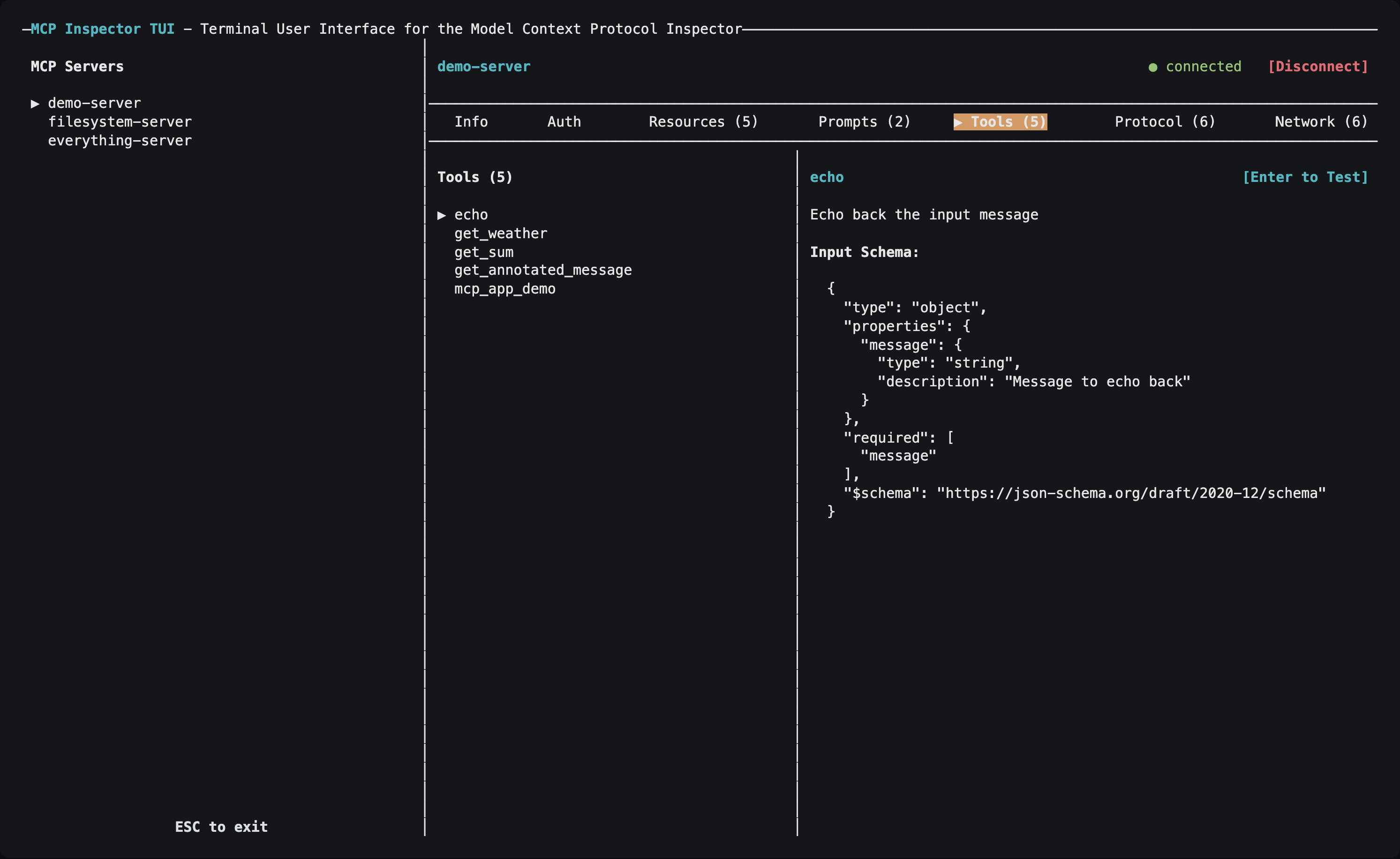
Running the TUI
You can run the TUI client via npx:
npx @modelcontextprotocol/inspector --tui node build/index.js
With Configuration Files
The TUI can load all servers from an MCP catalog/config file. With no source
flag it uses the default writable catalog ~/.mcp-inspector/mcp.json (seeded
empty if missing):
npx @modelcontextprotocol/inspector --tui --catalog mcp.json   # writable catalog (seeded empty if missing)
npx @modelcontextprotocol/inspector --tui --config mcp.json    # read-only session (errors if absent)
(It does not use --server; all servers in the file are available in the TUI.)
Options
MCP server (which server(s) to connect to)
Options that specify the MCP server(s) (catalog/config file, ad-hoc command/URL, env vars, headers) are shared by the Web, CLI, and TUI and are documented in MCP server configuration: --catalog (writable catalog, seeded empty if missing; default ~/.mcp-inspector/mcp.json or MCP_CATALOG_PATH), --config (read-only session, errors if absent), -e, --cwd, --header, --transport, --server-url, and the positional [target...]. --catalog and --config are mutually exclusive, and neither combines with an ad-hoc target.
TUI-specific (OAuth for HTTP servers)
The TUI supports OAuth for SSE and Streamable HTTP servers. Per-server OAuth fields in mcp.json (static client id/secret, scopes, enterprise-managed flag) are applied automatically when loaded from --catalog or --config. Install-wide settings (CIMD, enterprise IdP) come from ~/.mcp-inspector/storage/client.json — the same file the web Client Settings dialog writes. You can point at a different file with --client-config or MCP_CLIENT_CONFIG_PATH.
OAuth callback URL
The TUI starts a small loopback HTTP server to receive the authorization redirect after you sign in in the browser. Defaults:
| Surface | Default callback |
|---|---|
| Web | http://localhost:6274/oauth/callback (main app server) |
| TUI | http://127.0.0.1:6276/oauth/callback (dedicated runner port; avoids colliding with web on 6274) |
Why a fixed default port? Enterprise-managed auth (EMA), CIMD, and many static OAuth apps require pre-registered redirect URIs. A predictable default (http://127.0.0.1:6276/oauth/callback) lets you register once on the IdP and reuse it across TUI sessions. Dynamic registration (DCR) can use ephemeral ports instead — see below.
Trade-off: only one TUI OAuth flow at a time can listen on the default port. A second instance starting OAuth while another is in progress may fail with EADDRINUSE. Override the listener with --callback-url or MCP_OAUTH_CALLBACK_URL (e.g. a different fixed port per instance, or http://127.0.0.1:0/oauth/callback when the authorization server accepts dynamically registered redirect URIs).
OAuth redirect URIs must match exactly what you register on the authorization server — localhost and 127.0.0.1 are different URIs. Register the TUI default on your OAuth app / IdP when using pre-registered (static), CIMD, or enterprise-managed clients. Override the listener with --callback-url or MCP_OAUTH_CALLBACK_URL; use http://127.0.0.1:0/oauth/callback for an OS-assigned ephemeral port when the authorization server registers redirect URIs dynamically (DCR).
Flags
| Option | Env | Description |
|---|---|---|
--client-config <path> |
MCP_CLIENT_CONFIG_PATH |
Install-level client config (default: ~/.mcp-inspector/storage/client.json). |
--client-id <id> |
— | OAuth client ID (static client); overrides client.json. |
--client-secret <secret> |
— | OAuth client secret (confidential clients); overrides client.json. |
--client-metadata-url <url> |
— | Client ID Metadata Document URL (CIMD); overrides client.json. |
--callback-url <url> |
MCP_OAUTH_CALLBACK_URL |
OAuth redirect/callback listener (default: http://127.0.0.1:6276/oauth/callback). Must bind a loopback host (localhost / 127.0.0.0/8 / [::1]); a non-loopback host hard-errors, since the listener receives the authorization code over plaintext http. |
Authenticating in the TUI
- Select an HTTP/SSE server and press C to connect.
- If authorization is required, the TUI starts OAuth automatically (browser opens for sign-in).
- After the callback completes, connect finishes without a second C.
- Use the Auth tab to inspect OAuth state (same fields as web Connection Info) or Clear OAuth state (disconnects when connected).
See also EMA / enterprise-managed auth and OAuth smoke testing for staging servers and verification steps.
Features
The TUI provides terminal-native tabs and panes for interacting with your MCP server:
- Resources: Browse and read resources exposed by the server.
- Prompts: List and test prompts.
- Tools: View available tools and execute them with form-like inputs.
- Protocol: View JSON-RPC request/response/notification history (matches the web Protocol monitor).
- Network: View HTTP fetch traffic for SSE / Streamable HTTP servers (matches the web Network monitor).
- Console: View stdio stderr from the connected server process (matches the web Console monitor).
Navigation
- Use the Arrow Keys (Left/Right) or Tab to switch between the main tabs (Resources, Tools, Prompts, etc.).
- Use the Arrow Keys (Up/Down) to scroll through lists of items.
- Press Enter to select an item, execute a tool, or fetch a resource.
- Press Escape or
Ctrl+Cto exit the application.
Development
Like the other clients, the TUI self-validates from its own folder:
npm run validate       # format:check && lint && build && test:coverage
npm test               # run all tests
npm run test:coverage  # run tests under the per-file coverage gate
The repo-root validate:tui just delegates here. eslint.config.js registers
react-hooks for the classic rules only (rules-of-hooks + exhaustive-deps); the
stricter react-hooks@7 rules are not enforced on the interim component surface
(#1501).
Tests live in __tests__/. The coverage gate covers all of src/**, React
surface included — the Ink components mount through ink-testing-library (with
the ink-scroll-view / ink-form passthrough doubles in __tests__/helpers/),
App.tsx mounts against a mock of the @inspector/core surface, and keypresses
are driven through stdin. The former interim exclusion of the components and
App.tsx was lifted in #1501; the only exclusion left in vitest.config.ts is
src/tui-servers.ts, a pure re-export of core's server resolver with no runtime
statements of its own (its logic is measured in core/ via the web suite, and
tui-servers.test.ts still exercises it behaviorally — it is excluded only so it
doesn't surface as a misleading 0/0 row).
Bundling: React-rendering dependencies must be inlined (#1952)
tsup.config.ts splits the TUI's dependencies into bundled (noExternal) and
externalized (external). For anything that renders React components, that
choice decides which React instance it gets at runtime, and getting it wrong
crashes the TUI in a way nothing in this repo can see.
An external package's import "react" resolves from wherever npm placed that
package — and npm places it next to a React satisfying its own peer range.
ink-form and ink-scroll-view both accept react: ">=18", so a project that
installs the Inspector alongside its own React 18 satisfies them: they hoist to
that project's root while the Inspector's React 19 nests underneath. The bundle
then renders through React 19 while those two call hooks on React 18, whose
dispatcher is null — so opening a tool test form (or any scroll view) dies with
TypeError: Cannot read properties of null (reading 'useState').
Bundling them removes npm from the decision: their import "react" is emitted
into build/index.js, so it resolves from the build directory exactly like the
bundle's own. It also pins their transitive deps to what this install
resolved — notably ink-select-input@6 via the overrides entry, since npm
ignores a dependency's overrides and a consumer install would otherwise pull
the React-18-era v5 that ink-form asks for.
ink itself stays external: it can't be bundled (its CJS signal-exit@3
dependency fails ESM interop with Dynamic require of "assert" is not supported), and it doesn't need to be — its react peer is ">=19", which
keeps npm from hoisting it next to a React the Inspector couldn't also use.
__tests__/tsupConfig.test.ts enforces this: every dependency declaring a
react peer must be in noExternal unless it is listed as external by design.
Add a React-rendering dependency, and that test tells you to bundle it.
The ink-form label patch
Bundling ink-form also makes it patchable, which one label needs: the hint
under an incomplete form reads "you have not competed yet". It is upstream's
string, hardcoded in ink-form/lib/SubmitButton.js with no prop to override,
and ink-form was last published in 2024 — so tsup.config.ts corrects it with
an esbuild onLoad hook as the file enters the bundle. It is reported upstream
as lukasbach/ink-form#14; if
a release ever carries the fix, drop the patch.
The hook throws when the string isn't found rather than passing the source
through. A silent no-op would let an ink-form upgrade retire the patch without
anyone noticing it had stopped applying — or leave a patch aimed at a string
that no longer exists. If the build fails there, check whether upstream fixed
the typo and delete the patch instead of re-targeting it.