- TypeScript 90.8%
- JavaScript 8.8%
- CSS 0.2%
- HTML 0.2%
| Filename | Latest commit message | Latest commit date |
|---|---|---|
 d9e4f444a2 * test(cli,tui): typecheck the __tests__ dirs (#1791) The cli/tui `typecheck` scripts only checked `src` (the src-only tsconfig excludes `**/*.test.*`), leaving the `__tests__` dirs — which do the most `as` casting — with no tsc pass. Add a `tsconfig.test.json` per client that includes `__tests__` with the test-exclusions dropped and the test-only path aliases (`@modelcontextprotocol/inspector-test-server`, the `@inspector/core/*` deep paths, express/vitest) resolving what vitest resolves, then fold `tsc -p tsconfig.test.json` into each `typecheck`. Fixes the 76 errors it surfaced: - cli: a wrong `@modelcontextprotocol/inspector-core/...` module specifier (should be `@inspector/core/...`; only a type import so vitest never caught it), `r.headers` optional-access guards, and partial OAuth mocks replaced with typed `makeFakeCliOAuthClient()` / `makeFakeServerSettings()` factories instead of `as` casts. Adds `@types/express` (devDep) so the transitively aliased test-server source typechecks, mirroring clients/web. - tui: rest-param signatures on the App OAuth spies (fixes the spread-arg and narrow-return errors), a widened callback param (`iss?`), a `makeFakeServer- Settings()` factory for the tuiOAuth tests, required OAuth-metadata/client fields in AuthTab, and a loosened `entry()` message param for the deliberately-malformed wire messages HistoryTab's defensive branches render. Gate coverage only; no runtime behavior change. Co-Authored-By: Claude Opus 4.8 (1M context) <noreply@anthropic.com> Claude-Session: https://claude.ai/code/session_01XNdjEPKLG637X8YmhDiEk5 * test(cli,tui): address review — real spy signatures, config typecheck, nits Responds to the @claude review of #1799: - App.test.tsx: type the OAuth spies against the real InspectorClient method signatures (`vi.fn<InspectorClient["…"]>()`) and forward `Parameters<…>` tuples from the FakeClient wrappers, so `toHaveBeenCalledWith(...)` on the six OAuth-lifecycle spies stays argument-checked under the new gate rather than accepting anything via `unknown[]`. `getOAuthState` regains its wide `OAuthConnectionState | undefined` return. - Typecheck the client config files too: add `vitest.config.ts` / `tsup.config.ts` (and tui `dev.ts`) to each src `tsconfig.json` include — they were the one first-party surface still getting no tsc pass. - Trim the redundant `src/**/*` from each `tsconfig.test.json` include (tsc pulls in the src the tests import; the src-only config already checks it). - Rename the tui settings helper to `oauth-test-fakes.ts` to match cli's, and soften both factories' docstrings to stop naming a loader they don't mirror field-for-field. - Fix a stale `@modelcontextprotocol/inspector-core/...` specifier in a createRemoteTransport JSDoc example (the same wrong package name the gate caught in the cli tests, surviving in a comment). Co-Authored-By: Claude Opus 4.8 (1M context) <noreply@anthropic.com> Claude-Session: https://claude.ai/code/session_01XNdjEPKLG637X8YmhDiEk5 * test: address round-2 review — correct claims, tighten types, typecheck launcher Responds to the round-2 @claude review of #1799: - Correct the toHaveBeenCalledWith claim: vitest doesn't type-check `toHaveBeenCalledWith(...)` arguments against the mock's signature, so the App.test.tsx comment no longer claims it does — the typed spies buy checked implementations/return payloads (the stale-literal fix), not arg-checking. - authenticate spy now uses the real `InspectorClient["authenticate"]` signature (returns a `URL`), so it no longer diverges from production; the one mockResolvedValue is updated to a URL. - makeFakeCliOAuthClient members are typed against the real CliOAuthClient signatures (not bare vi.fn()), so a wrong-signature override is rejected. - HistoryTab: revert the `entry()` `message: unknown` widening (it un-checked the ~15 well-formed fixtures) and instead scope a named `MALFORMED` cast to the two intentionally-malformed messages. - Typecheck the launcher `__tests__` too (the same gate hole in the one client the PR hadn't touched): new clients/launcher/tsconfig.test.json + a typecheck script folded into validate. Completes the "every client's __tests__ is typechecked" invariant. - Doc the new test-typecheck + config-file typecheck in AGENTS.md. Co-Authored-By: Claude Opus 4.8 (1M context) <noreply@anthropic.com> Claude-Session: https://claude.ai/code/session_01XNdjEPKLG637X8YmhDiEk5 * test: address round-3 nits — launcher config typecheck, callTool typed, docs Responds to the round-3 @claude review of #1799 (all non-blocking): - launcher: add `vitest.config.ts` to tsconfig.test.json's include (it was in neither project — the build config's rootDir: ./src rejects it). Now typechecked. - App.test.tsx: type `callTool` against `InspectorClient["callTool"]` (+ the Parameters<…> wrapper) so its `mockResolvedValue` payloads are checked, and give `clearOAuthTokens` an `async () => {}` impl so the mock actually returns the `Promise<void>` its type promises. - AGENTS.md: correct the per-client alias-set description (cli's is widest, tui's is core+react only, launcher's has no paths) and note launcher's config file lives in its test project, not the src project. Co-Authored-By: Claude Opus 4.8 (1M context) <noreply@anthropic.com> Claude-Session: https://claude.ai/code/session_01XNdjEPKLG637X8YmhDiEk5 * test: address round-4 — durable typecheck-coverage guard + launcher/doc nits Responds to the round-4 @claude review of #1799 (all non-blocking): - Add `verify:typecheck-coverage` (scripts/verify-typecheck-coverage.mjs), the typecheck-coverage analog of verify:format-coverage and the durable guard for the invariant this PR establishes: for each Node client it runs the tsconfig projects its `typecheck` names with `tsc --listFiles`, unions them, and fails on any tracked .ts/.tsx that lands in no project. This closes the class the review kept surfacing by hand (launcher/__tests__ in round 3, launcher/vitest.config.ts in round 4) — a new top-level file can no longer go untypechecked silently. Wired into `npm run ci` and the GitHub workflow. - launcher: reorder `validate` to run `typecheck` before `build` (matches tui and the documented order), and make `typecheck` self-contained — it now runs both `tsconfig.json` and `tsconfig.test.json`, so running it standalone means the same thing it does in cli/tui. - makeFakeCliOAuthClient: note on the comment that the typing covers the defaults, not `overrides` (a bare vi.fn() override is Mock<(...args)=>any>). - Docs: README table + AGENTS.md updated for the new guard and the corrected launcher typecheck/validate ordering. Co-Authored-By: Claude Opus 4.8 (1M context) <noreply@anthropic.com> Claude-Session: https://claude.ai/code/session_01XNdjEPKLG637X8YmhDiEk5 * test: address round-5 — wire-check the guard, --listFilesOnly, into validate Responds to the round-5 @claude review of #1799: - Finding 1 (the pre-merge one): the guard now ports verify:format-coverage's reachability checks — it asserts each client's `typecheck` is reachable from its own `validate` and that the root chain runs each client's `validate`, so it can't stay green while measuring a typecheck nothing invokes. Verified: stripping `npm run typecheck` from launcher's validate now fails the guard. - Nit 3: switch `tsc --listFiles` → `tsc --listFilesOnly` (identical file list, ~4× faster: whole guard 23s → ~4s). Now cheap enough for the inner loop, so it moves into `validate` (right after verify:format-coverage) instead of a standalone ci step — matching its sibling. Removed the separate ci-chain entry and GitHub workflow step (validate covers it). - Nit 4: `npx --no-install tsc` so a missing local tsc fails fast instead of reaching for the registry (matches verify-build-gate.mjs). - Nit 5: corrected projectFiles' JSDoc to describe the filter that's actually there (drops repo-external + node_modules paths; core/ + test-servers/ stay but are harmless). - Finding 2: fixed the 2-space misindent on the new root package.json line (prettier --write). Docs (README/AGENTS) updated for the validate placement. Co-Authored-By: Claude Opus 4.8 (1M context) <noreply@anthropic.com> Claude-Session: https://claude.ai/code/session_01XNdjEPKLG637X8YmhDiEk5 * chore(scripts): address round-6 guard nits — dedupe wiring, robust diagnostics Responds to the round-6 @claude review of #1799 (all guard-ergonomics nits): - Nit 2: extract the shared reachability logic (`reachableScripts`, `rootRunsClientValidate`) into scripts/lib/npm-scripts.mjs and consume it from BOTH verify-format-coverage.mjs and verify-typecheck-coverage.mjs, so the "is this gate actually run?" wiring can't drift between them (same rationale as scripts/lib/prod-web-server.mjs). - Nit 1: typecheckProjects now harvests `-p`/`--project` from every script reachable from `typecheck` (not the single string), so a delegating `typecheck` (`npm run typecheck:src && …`) is handled instead of failing with a false "names no -p project" diagnosis. Also accepts `--project`. - Nit 3: on a tsc config error, echo the `error TS…` diagnostic (scanning both streams — tsc prints config errors to stdout) so a broken tsconfig is self-explaining rather than surfacing only as a misleading "file in no project" report. - Nit 4: refreshed the CI workflow's stale "Validate" step name/comment (it now runs the coverage guards + validate:core + per-client typecheck). - Nit 5: reworded the `.d.ts` carve-out comment to read as pre-emptive (there are none under cli/tui/launcher today). Co-Authored-By: Claude Opus 4.8 (1M context) <noreply@anthropic.com> Claude-Session: https://claude.ai/code/session_01XNdjEPKLG637X8YmhDiEk5 * chore(scripts): round-7 — guard .mts/.cts too; drop dead export Responds to the round-7 @claude review of #1799: - Finding 1: verify-typecheck-coverage now requires a tsc pass for tracked `.mts`/`.cts` (not just `.ts`/`.tsx`), matching verify-format-coverage's extension set — `.mts` is already the shared-config idiom here, so a client `vitest.config.ts` → `.mts` rename can no longer drop out of both the tsconfig include and the guard's required set. No-op on today's tree (no client `.mts`/`.cts`); confirmed a tracked `.mts` with a type error is now caught. Ambient `.d.{ts,mts,cts}` stay excluded. - Nit 2: drop the unused `export` on `rootReachedCommands` (internal to the lib; nothing imports it, and scripts/ isn't eslint-gated to catch dead exports). Co-Authored-By: Claude Opus 4.8 (1M context) <noreply@anthropic.com> Claude-Session: https://claude.ai/code/session_01XNdjEPKLG637X8YmhDiEk5 * test: round-8 — single casts in HistoryTab, uniform wrappers, doc scope Responds to the round-8 @claude review of #1799: - Finding 1: reduce the `MALFORMED` helper and `entry()`'s return cast from `as unknown as` to a single `as` (both compile clean — the malformed shapes are comparable to the JSONRPCMessage union), and delete the false "only option" sentence. Fixes the AGENTS.md avoid-double-casts violation. - Nit 3: write all seven FakeClient OAuth wrappers as `(...a: Parameters<InspectorClient["…"]>)` (the three zero-arg ones were hand-written `()` forwarders), so the block comment's "forward the same Parameters<…> tuple" is literally true and a future added parameter can't be silently dropped. - Nit 2: update the five places that still described the guard as `.ts`/`.tsx` only to `.ts`/`.tsx`/`.mts`/`.cts` (script header + trackedSourceFiles JSDoc, AGENTS.md ×2, README.md). Nits 4 (js config files out of the typecheck guard by construction) and the footnoted callTool/ancestor-tsc items left as agreed. Co-Authored-By: Claude Opus 4.8 (1M context) <noreply@anthropic.com> Claude-Session: https://claude.ai/code/session_01XNdjEPKLG637X8YmhDiEk5 * test: round-9 — drop entry()'s harmful cast; guards vouch for each other Responds to the round-9 @claude review of #1799: - Finding 1: remove `entry()`'s `as MessageEntry` return cast in HistoryTab.test.tsx. It was unnecessary (the spread of Partial<MessageEntry> over complete defaults is directly assignable) and harmful — it silenced type errors in the helper's OWN default fields (a `direction`/`method` typo now surfaces TS2820/TS2353). MALFORMED's single cast stays (load-bearing). This leaves MALFORMED as the file's only cast, matching what the comments describe. - Nit 2: add `rootReachesScript` to scripts/lib/npm-scripts.mjs and have each coverage guard assert its SIBLING is still wired into the root `validate`. A guard can't detect being unrun itself, but the two now vouch for each other, so dropping either from `validate` is caught by the other (only deleting both slips through). Verified: removing verify:typecheck-coverage from validate now fails verify:format-coverage, and vice-versa. Nits 3 (git-index visibility) and 4 (pre-existing as-never/as-unknown casts in tests — out of scope, none added by this PR) left as agreed. Co-Authored-By: Claude Opus 4.8 (1M context) <noreply@anthropic.com> Claude-Session: https://claude.ai/code/session_01XNdjEPKLG637X8YmhDiEk5 * test: round-10 — reject non-checking typecheck passes; pre/post hooks; docs Responds to the round-10 @claude review of #1799: - Finding 1: verify-typecheck-coverage now rejects a `-p <project>` whose own command carries `--noCheck` or `--listFilesOnly` — such a pass lists files without type-checking them, which previously satisfied both the wiring and file-coverage halves while checking nothing. (Splits each script on `&&`/`||`/`;` so a flag on one command can't taint another.) Verified a `typecheck` using `tsc … --noCheck` now fails with a clear message; `--noCheck` is a live idiom here (cli's test-servers:build), so this is a real copy-paste hazard. - Nit 2: reachableScripts (shared lib) now also follows npm's implicit `pre<name>`/`post<name>` lifecycle hooks, so moving a gate into e.g. `prevalidate` is recognized instead of producing a false "not reachable" failure (cli already uses a `pretest` hook). Verified. - Nit 3: AGENTS.md "Test placement" now states the Node clients (cli/tui/ launcher) keep all tests in `__tests__/`, enforced by verify:typecheck-coverage (a co-located src test lands in no tsconfig project). - Nit 4: noted on the factory comments that `Partial<…>` overrides admit an explicit `undefined` for a required field (exactOptionalPropertyTypes off). Co-Authored-By: Claude Opus 4.8 (1M context) <noreply@anthropic.com> Claude-Session: https://claude.ai/code/session_01XNdjEPKLG637X8YmhDiEk5 * fix: round-11 — launcher build excludes tests; guard catches all noCheck vectors Responds to the round-11 @claude review of #1799: - Finding 1 (shipping bug): clients/launcher/tsconfig.json now excludes `**/*.test.{ts,tsx}` (matching cli/tui). launcher's `build` is an EMITTING tsc over src/**, and clients/launcher/build is in the root `files` allowlist, so a co-located `src/**/*.test.ts` would have been compiled into the published tarball. Excluding it also makes such a test land in no tsconfig project, so verify:typecheck-coverage catches it — making the AGENTS.md placement rule literally true for all three clients. - Finding 2: verify-typecheck-coverage now catches both remaining ways a typecheck could check nothing: (a) case-insensitive `--noCheck`/`--nocheck`/ `--listFilesOnly` on the command, and (b) `noCheck` set in the tsconfig itself (detected via `tsc --showConfig`, which surfaces it from the config or its extends chain). Verified both fail the guard. - Nits 3 & 4: restructured into an explicit gate-integrity phase (wiring + neutered + config-noCheck + no-projects) that reports under its own accurate header and exits BEFORE the file-coverage pass — so an inert gate no longer prints file-remediation advice, nor buries the real cause under an "in no tsconfig project" line for every file that gate covered. The one CIMD OAuth E2E integration test that flaked in the coverage run passes 32/32 in isolation and on re-run; unrelated to these script/config changes. Co-Authored-By: Claude Opus 4.8 (1M context) <noreply@anthropic.com> Claude-Session: https://claude.ai/code/session_01XNdjEPKLG637X8YmhDiEk5 * fix: round-12 — exclude .mts/.cts tests from build; drop false integrity line Responds to the round-12 @claude review of #1799: - Finding 1 (tarball, again): the round-11 test exclude only covered `.ts`/`.tsx`, so a co-located `src/*.test.mts` still compiled into launcher's shipped `build/`. All three clients now exclude `**/*.test.*` (one glob, covering .ts/.tsx/.mts/.cts) — which is also exactly what AGENTS.md already claims. Verified a `src/probe.test.mts` is no longer emitted and now fails the guard. - Finding 2: the gate-integrity phase no longer prints a false "names no `-p <project>`" line when config-`noCheck` disables projects — the condition now keys off `projects.length` (harvested), not `checking.length` (post- filter), so a client whose projects were all config-disabled shows only the accurate per-project lines. - Nit 3: recorded the boundary on the phase comment — it does not detect shell-level failure suppression (`… || true`, `; exit 0`). - Nit 5: the file-coverage remediation now leads with "for a co-located test, move it to `__tests__/`" (adding it to the src `include` would reintroduce the build emit) before the general add-to-include advice. Co-Authored-By: Claude Opus 4.8 (1M context) <noreply@anthropic.com> Claude-Session: https://claude.ai/code/session_01XNdjEPKLG637X8YmhDiEk5 * chore(scripts): round-13 — implicit-tsconfig + derived clients; diagnostics Responds to the round-13 @claude review of #1799: - Finding 1: verify-typecheck-coverage now understands a `tsc` command with no `-p`/`-b` project flag — it resolves the implicit `./tsconfig.json` (tsc's own default), so the idiomatic `tsc --noEmit` form counts as coverage instead of producing false "in no tsconfig project" failures. Also harvests `-b`/`--build` project paths. Verified `tsc --noEmit && tsc --noEmit -p tsconfig.test.json` now reports OK. - Finding 2: CLIENTS is no longer hardcoded — it's derived from the `cd clients/<x> && npm run validate` entries in the root `validate` chain (minus an explicit web exclusion), so a new Node client is auto-required, matching the repo-wide reach of its sibling verify-format-coverage. Added a guard-would-check-nothing bail if the derivation yields an empty set. Verified a new `clients/newclient` is picked up and its uncovered file flagged. - Nit 3: the phase-2 remediation now leads with the general add-to-`include` advice and only appends the "move it to __tests__/" note when a failing path is actually a test file (was misdirecting plain files). - Nit 4: AGENTS.md no longer says the test config includes "only" __tests__ (launcher's also includes its vitest.config.ts). (Two different web integration tests each flaked once under parallel load during the coverage runs — both pass in isolation and on a clean re-run; timing- sensitive and unrelated to these script/doc-only changes.) Co-Authored-By: Claude Opus 4.8 (1M context) <noreply@anthropic.com> Claude-Session: https://claude.ai/code/session_01XNdjEPKLG637X8YmhDiEk5 * chore(scripts): round-14 — enumerate clients from disk (fail-closed) Responds to the round-14 @claude review of #1799: - Finding 1: replace the root-chain `CLIENTS` derivation (round 13) with a disk enumeration — every `clients/<name>` whose package.json has a `typecheck` script. The chain derivation was fail-open: a root-chain edit that kept running a client but didn't match the strict regex silently dropped it from the required set (112→53 files, still green). Disk is fail-closed — a client can't be silently dropped, a new client with a typecheck is auto-required, and web (no typecheck script; builds via `tsc -b`) is excluded on its own, so the explicit exclusion is gone. The existing `rootRunsClientValidate` wiring check still verifies the root chain runs each — now LOUD when it doesn't. Verified: `cd ./clients/tui && …` now hard-fails the integrity phase instead of silently shrinking coverage; `cd clients/tui && npm run build && npm run validate` stays gated. Removed the now-unused `clientsRunByRootValidate` from the shared lib. - Nits 2 & 3: documented the two unreachable-today limitations on typecheckProjects — a solution-style `tsc -b` (empty `files` + `references`) would under-report, and the implicit-tsconfig fallback assumes no file operands. - Nit 4: refreshed the file header to mention `-b`/`--build` + the implicit `./tsconfig.json` (only the JSDoc had been updated). Co-Authored-By: Claude Opus 4.8 (1M context) <noreply@anthropic.com> Claude-Session: https://claude.ai/code/session_01XNdjEPKLG637X8YmhDiEk5 * chore(scripts): round-15 — enroll-or-exempt enumeration; normalize `cd ./` Responds to the round-15 @claude review of #1799: - Finding 1: the disk enumeration keyed on the presence of a script named `typecheck`, so renaming it silently dropped the client (112→53, still green) — contradicting the docstring. Now every `clients/*` with a readable package.json must EITHER declare a `typecheck` (→ enrolled) OR be in an explicit EXEMPT map (`clients/web`, reason: `tsc -b`); anything else is a hard gate-integrity failure. This is fail-closed on the rename axis too, and web's skip is a stated decision rather than an accident of which scripts it declares — so web gaining a `typecheck` no longer auto-enrolls it into the solution-`-b` false failures. Verified: renaming tui's `typecheck` now hard-fails; a `tsc -b` on web stays exempt. - Nit 3: `rootRunsClientValidate` normalizes a leading `./`, so `cd ./clients/tui && npm run validate` (which genuinely runs it) is no longer a false "no longer runs" alarm. - Nit 2: README/AGENTS/script-header prose no longer names a fixed cli/tui/launcher scope — they describe the disk-discovered "every clients/* with a typecheck script (web exempt)" rule. Co-Authored-By: Claude Opus 4.8 (1M context) <noreply@anthropic.com> Claude-Session: https://claude.ai/code/session_01XNdjEPKLG637X8YmhDiEk5 * chore(scripts): round-16 — anchor wiring match; close enumeration axes Responds to the round-16 @claude review of #1799: - Finding 1 (only false-PASS): rootRunsClientValidate matched the client dir as a bare substring, so a prefix-sibling (`clients/tui` vs `clients/tui-next`) satisfied the wiring check for the shorter name — dropping a client from the root chain went green if a sibling was present. Now an anchored regex (escaped dir + optional leading `./` + a trailing boundary). Verified the sibling case now hard-fails. - Nit 2: a `clients/*` dir holding tracked TS but no readable package.json is now a gate-integrity failure (was treated as "not a client"), so the "fail-closed on every axis" claim holds. Verified. - Nit 3: readdirSync is wrapped, so a missing `clients/` dir yields the intended "found no clients/* dir" message rather than a raw ENOENT stack. - Nit 4: EXEMPT's reason is now surfaced in the success line ("clients/web exempt: typechecks via tsc -b …"), so the exemption is visible at runtime, not only in source. (Also moved `isRequiredSource` above nodeClients — nit 2's new tracked-TS check calls trackedSourceFiles at module-init, which referenced it before init.) Co-Authored-By: Claude Opus 4.8 (1M context) <noreply@anthropic.com> Claude-Session: https://claude.ai/code/session_01XNdjEPKLG637X8YmhDiEk5 * chore(scripts): round-17 — share quote-aware tokenizer between guards Responds to the round-17 @claude review of #1799: - Finding 1: the two coverage guards parsed shell strings differently — verify-format-coverage had a quote-aware tokenize(); verify-typecheck-coverage used a raw regex. So a quoted `-p "tsconfig.test.json"` (a form tsc accepts) made the typecheck guard report every file that project covers as uncovered, and a quoted `cd "clients/tui"` in the root chain tripped a false wiring failure. Moved tokenize() (now single+double quote) into the shared lib, imported it into both guards, rewrote typecheckProjects to walk tokens (`-p`/`--project`/`-b`/`--build` → next token), and strip quotes before the `cd` match in rootRunsClientValidate. Verified both quoted forms now pass. - Nit 2: a stale EXEMPT key (a dir that no longer exists) was asserted in the success line unchecked. nodeClients now fails if an EXEMPT key isn't a real `clients/*` directory. Verified. - Nit 3 (build/dist filter belt-and-braces) left as a recorded boundary. Co-Authored-By: Claude Opus 4.8 (1M context) <noreply@anthropic.com> Claude-Session: https://claude.ai/code/session_01XNdjEPKLG637X8YmhDiEk5 * chore(scripts): round-18 — match tsc by basename; strip quotes on both halves Responds to the round-18 @claude review of #1799: - Finding 1 (regression from round 17): `tokens.includes("tsc")` didn't match a path-invoked binary (`node_modules/.bin/tsc`), which the previous `\btsc\b` regex did — so such a `typecheck` was falsely reported as naming no project. Now matches on the token basename (`isTsc`), keeping round-17's quoting fix while restoring the tolerance. Verified a `node_modules/.bin/tsc` typecheck reports OK. - Nit 2: `rootRunsClientValidate` stripped quotes for the `cd` match but tested `npm run validate` against the unstripped string, so `npm run "validate"` false-failed. Both halves now test the stripped string. - Nits 3 & 4: documented on typecheckProjects — the contrived `--noCheck false` (checking on) is still treated as disabling, and the `&&`/`||`/`;` split runs before tokenizing (a quoted operator inside an arg would split mid-token, unreachable for project paths). Co-Authored-By: Claude Opus 4.8 (1M context) <noreply@anthropic.com> Claude-Session: https://claude.ai/code/session_01XNdjEPKLG637X8YmhDiEk5 * test: round-19 — typecheck test-servers' unimported bin; --prefix wiring form Responds to the round-19 @claude review of #1799: - Finding 1: `test-servers/src/server-composable.ts` (a `#!/usr/bin/env node` bin entry nothing imports) got no tsc pass — the barrel alias covers the other 13 test-servers/src files transitively, but not this one, and its own build runs `tsc --noCheck`, so its errors were emitted into `test-servers/build` unchecked. Added it explicitly to `clients/cli/tsconfig.test.json`'s include (zero source changes; verified a bad line in it now fails cli's typecheck). Softened the AGENTS.md clause that implied the whole test-server source is transitively covered. - Nit 2: `rootRunsClientValidate` now also recognizes the `npm --prefix <dir> run validate` invocation form (was `cd`-only). - Nit 3 (stderr spy drops the completion-callback overload): left as-is — latent, not live (no exercised path awaits a stderr drain), and adding typed overload params would reintroduce the write-overload complexity the round-1 vi.spyOn refactor removed. Co-Authored-By: Claude Opus 4.8 (1M context) <noreply@anthropic.com> Claude-Session: https://claude.ai/code/session_01XNdjEPKLG637X8YmhDiEk5 * chore(scripts): round-20 — anchor validate tail; guard shared-source class Responds to the round-20 @claude review of #1799: - Finding 1 (false PASS): the wiring matcher's tail `/\brun validate\b/` also matched `run validate:fast` (`:` is a word boundary) — a DIFFERENT script that may skip typecheck. So the root chain could run a client's `validate:fast` while the guard kept measuring its `validate` (unrun), green. Anchored the tail to a boundary (`/\brun validate(?=$|[\s&;])/`). Verified `validate:fast` now hard-fails. - Finding 2: durably close the test-servers/src class instead of point-fixing. Added a SHARED_ROOTS check — every tracked TS under `test-servers/src` + the root `vitest.shared.mts` (the `format:check:shared`/`lint:shared` surface) must land in the GLOBAL union of client projects. So a NEW unimported bin entry is caught (not just server-composable.ts, named in round 19). Verified a fresh `server-orphan-bin.ts` now fails. Zero source changes — the union already covers 15/15. - Nit 4: the integrity message and rootRunsClientValidate docstring now mention the `npm --prefix` form too. Co-Authored-By: Claude Opus 4.8 (1M context) <noreply@anthropic.com> Claude-Session: https://claude.ai/code/session_01XNdjEPKLG637X8YmhDiEk5 * chore(scripts): round-21 — deny-by-default non-client coverage Responds to the round-21 @claude review of #1799 (findings 1 & 2, one fix): - Replaced the `SHARED_ROOTS` allowlist with a deny-by-default non-client set: all tracked TS minus `clients/*` (per-client pass) minus a reasoned `core/` exemption (covered by web's `tsc -b`). This closes BOTH round-21 findings at once: - Finding 1 (stale allowlist fail-open): a rename of `test-servers/src` no longer silently drops it — its files reappear in the required "other" set and hard-fail (verified: `git mv test-servers/src test-servers/source` now fails instead of going 127→113 green). The subtractive `core/` exemption is fail-closed on staleness for the same reason. - Finding 2 (allowlist vs deny-by-default): a new top-level TS location is now auto-required (verified `tools/probe.ts` is flagged), matching the repo-wide reach of the sibling verify-format-coverage. - Nit 3: added the shared-source clause to the README table row (AGENTS got it last round). Header comment updated to describe the non-client coverage. Co-Authored-By: Claude Opus 4.8 (1M context) <noreply@anthropic.com> Claude-Session: https://claude.ai/code/session_01XNdjEPKLG637X8YmhDiEk5 * chore(scripts): round-22 — narrow core/ exemption to what web's tsc -b covers Responds to the round-22 @claude review of #1799: - Finding 1: the `core/` exemption was whole-tree, but web's `tsc -b` only covers `core/**/*.ts` MINUS co-located `*.test.ts(x)` (its app project's include). So a `core/*.tsx`/`*.mts`/`*.cts` or a co-located `core` test got no tsc pass from anything. Narrowed the exemption to exactly that shape (`isExemptCoreFile`): a core `.ts` that isn't a co-located test. So a core `.tsx`/`.mts`/co-located test is now required in some project. Zero-fix today (0 such files); verified `core/mcp/probe-widget.tsx` and a co-located core `.test.ts` are now flagged. - Nit 2: `EXEMPT_ROOTS` is now a Map (dir → reason) and its reason is surfaced in the success line alongside the client exemption. - Nit 3: the non-client miss message is now the general "in no client's tsconfig project"; the `test-servers` remediation clause is conditional on an actual `test-servers/` path (tracked via `nonClientMisses`, not string-sniffing the composed message). - Nit 4: success line says "(N clients + non-client)". Co-Authored-By: Claude Opus 4.8 (1M context) <noreply@anthropic.com> Claude-Session: https://claude.ai/code/session_01XNdjEPKLG637X8YmhDiEk5 * chore(scripts): round-23 — core exemption mirrors both web projects Responds to the round-23 @claude review of #1799: - Finding 1: round 22's `isExemptCoreFile` mirrored only web's app project, but web's `tsc -b` also builds `tsconfig.test.json`, which includes `core/**/__tests__/**/*.{ts,tsx}`. So a `core/**/__tests__/*.test.ts` (a live layout — `core/mcp/__tests__/fakeInspectorClient.ts` already sits there) was flagged though web checks it. Now mirrors the UNION: under `__tests__/` → exempt `.ts`/`.tsx`; otherwise `.ts` minus co-located `*.test.ts(x)`. Verified a core `__tests__` test now passes while a core `.tsx` outside `__tests__` stays required. - Finding 2: `EXEMPT_ROOTS` was a Map whose keys nothing read (round 22 replaced its filter with hardcoded `isExemptCoreFile`) — a phantom registry. Collapsed to a single `CORE_EXEMPT_REASON` const used in the OK line. - Nit 3: README/AGENTS scope descriptions updated (core is no longer wholesale excluded; the non-client set is deny-by-default). Co-Authored-By: Claude Opus 4.8 (1M context) <noreply@anthropic.com> Claude-Session: https://claude.ai/code/session_01XNdjEPKLG637X8YmhDiEk5 * chore(scripts): round-24 — enroll clients/web via tsconfig references Responds to the round-24 @claude review of #1799: - Finding 1: `clients/web` was whole-tree EXEMPT, but web's `tsc -b` only reaches what its four referenced projects include — a file at web's package root (e.g. `playwright.config.ts`) got no tsc pass and passed EVERY gate, fully silently. This was the last whole-tree exemption wider than the gate it defers to. Now web is ENROLLED: a client with no `typecheck` script but a `tsconfig.json` `references` array is measured through those reference projects (`tsc -p <ref> --listFilesOnly`), and is wired iff its `validate` runs `tsc -b` (`validateRunsTscBuild`). EXEMPT is now the empty escape hatch. Verified: a web-root `playwright.config.ts` with a type error is now flagged, and dropping `tsc -b` from web's build hard-fails the integrity phase. Zero-fix on the tree — the union of web's 4 projects covers all 625 tracked web files. - Nit 2: assert `core/` exists (the OK line unconditionally states its exemption) — parity with the EXEMPT stale-key check. - Nit 3: a `core/` miss now gets core-specific remediation (widen web's `tsconfig.app.json` include, not a cli/tui project). - Nit 4: README/AGENTS scope descriptions corrected — web is enrolled (not exempt), and the exact core-exempt shape (app `*.ts` minus co-located tests + test `__tests__/**/*.{ts,tsx}`). Co-Authored-By: Claude Opus 4.8 (1M context) <noreply@anthropic.com> Claude-Session: https://claude.ai/code/session_01XNdjEPKLG637X8YmhDiEk5 * chore(scripts): round-25 — drop redundant core exemption; guard tsc -b --noCheck Responds to the round-25 @claude review of #1799: - Finding 1: enrolling web (round 24) made the hand-maintained `core/` exemption both redundant and fail-open — web's measured `tsc -b` projects already cover core, and the mirror could go stale (narrowing web's include let an unimported core error pass). Deleted `isExemptCoreFile`, `CORE_EXEMPT_REASON`, the core presence assertion, and the exemptNote core clause. `core/` is now required like everything else and covered by measurement (127→894 files; a `core/*.tsx` web doesn't reach is now caught by measurement, not a hand-model). Kept the core-specific remediation clause. - Finding 2: the reference (`tsc -b`) path skipped the non-inertness check — a `tsc -b --noCheck` build gated nothing while the guard stayed green. Turned `validateRunsTscBuild` into `tscBuildStatus` (ok/neutered/none); a neutered `tsc -b` now hard-fails, matching the typecheck-script path. Factored the disabling-flag predicate (`isDisablingFlag`) so both paths share it. - Nit 3: `clientTsconfigReferences` now strips block comments too (every other tsconfig in the repo uses `/* */`). - Nit 5: README/AGENTS wiring clause covers web's `tsc -b` (not just the `typecheck` script), and core is described as measured, not exempt. Nit 4 resolves itself: EXEMPT is empty and the exemptNote/ternary now collapse cleanly. Nit 6 (tsc -b bound to a specific tsconfig) left as recorded. Co-Authored-By: Claude Opus 4.8 (1M context) <noreply@anthropic.com> Claude-Session: https://claude.ai/code/session_01XNdjEPKLG637X8YmhDiEk5 * chore(scripts): round-26 — expand solution configs wherever harvested Responds to the round-26 @claude review of #1799: - Finding 1: the reference (`tsc -b`) path was selected only by "no typecheck script", so adding `typecheck: "tsc -b"` to web (the natural uniformity move) flipped it to the typecheck-script path, where the harvested solution config lists nothing → 665 false failures. Fixed at the measurement layer: projectFiles now expands a solution config (`{"files":[], "references":[…]}` — lists nothing under --listFilesOnly) to its references and measures those recursively, so a `tsc -b` project is measured no matter which path harvests it. Generalized the references reader (tsconfigReferences(path)). Verified web with `typecheck: "tsc -b"` now passes. Dropped the stale "web … is out of scope" JSDoc clause. - Nit 2: a `core/**/__tests__/**` miss now points at `tsconfig.test.json` (its actual owner), not `tsconfig.app.json`. - Nit 4: AGENTS.md's one-line summary now mentions the non-client (`core/`, `test-servers/src`) coverage, matching the detailed bullet. Nit 3 (EXEMPT empty, dormant stale-key check) left as the intended escape hatch. Co-Authored-By: Claude Opus 4.8 (1M context) <noreply@anthropic.com> Claude-Session: https://claude.ai/code/session_01XNdjEPKLG637X8YmhDiEk5 * chore(scripts): round-27 — non-inertness follows references on both paths Responds to the round-27 @claude review of #1799: - Finding 1: round 26 made COVERAGE follow a solution config's references, but the non-inertness (`noCheck`) check on the typecheck-script path still only inspected the harvested solution (empty compilerOptions) — so a `noCheck` in a REFERENCED project was invisible there (caught only on the reference path). Factored a shared `resolveLeafProjects` (a solution → its real leaf projects, cached rawProjectFiles) used by BOTH coverage (`projectFiles`) and a shared `checkingLeaves` disable-check, so a `noCheck` in a referenced project is now caught on either path. Verified: `typecheck: "tsc -b"` + `noCheck` in tsconfig.app.json now hard-fails (was green). Caching also cut the guard from ~20s to ~11s. - Nit 2: directory-form references (`{ "path": "./packages/a" }`) now resolve to `<dir>/tsconfig.json`, so a nested-solution dir reference is expanded. - Nit 3: reworded the empty-listFiles comment (it's "solution config OR errored config", both of which the reference expansion handles). - Nit 4: script header notes a `tsc -b` solution is reduced to its references on either enrollment path. Co-Authored-By: Claude Opus 4.8 (1M context) <noreply@anthropic.com> Claude-Session: https://claude.ai/code/session_01XNdjEPKLG637X8YmhDiEk5 * chore(scripts): round-28 — dedup shared leaf in checkingLeaves Responds to the round-28 @claude review of #1799 (which found no new gate hole): - Finding 1: `checkingLeaves` dedup'd the `checking` array but ran projectDisablesChecking + integrity.push on every visit, so a leaf reachable from two harvested projects produced a duplicate `noCheck` line (and a redundant `tsc --showConfig`). Now tracks visited leaves in a Set and skips an already-seen leaf entirely. Verified a duplicate harvested project yields one line, not two. - Nit 3 (record-completeness): noted in AGENTS that the one tier the guard structurally can't see — a per-file `// @ts-nocheck` — is owned by `@typescript-eslint/ban-ts-comment` across lint:core/lint:shared/each client. Nit 2 (the ~11s perf claim isn't reproducible on a CI-class runner) and nit 4 (hybrid-solution / composite boundaries, both tsc-rejected → unreachable) left as recorded. Co-Authored-By: Claude Opus 4.8 (1M context) <noreply@anthropic.com> Claude-Session: https://claude.ai/code/session_01XNdjEPKLG637X8YmhDiEk5 * test(scripts): unit-test the typecheck-coverage guard's parsers Responds to the round-29 @claude review of #1799 (no new gate hole; the finding is that the guard itself has no tests): - Made the guard's pure helpers importable: exported `typecheckProjects`, `tscBuildStatus`, `tsconfigReferences`, `clientTsconfigReferences`, `resolveLeafProjects`, `isTsc`, `isDisablingFlag`, `isRequiredSource`, and moved the module-init + phase execution behind an exported `main()` run only when the file is executed directly (importing it for tests no longer runs the guard). Behavior when run directly is unchanged (894 files). - Added table-driven tests (node's built-in `node --test`; the root has no vitest harness by design) for the shared lib (`tokenize`, `reachableScripts` incl. pre/post hooks, `rootRunsClientValidate` across cd/--prefix/quoted/ prefix-sibling/`validate:fast`, `rootReachesScript`) and the guard's parsers (`isRequiredSource`, `isTsc`, `isDisablingFlag`, `typecheckProjects`, `tscBuildStatus`) — one case per rule a review round found (r7/r10/r13/r15/ r16/r17/r18/r19/r20/r25). 12 tests. Wired `test:scripts` into `validate`. - Nit 2: a `scripts/*.ts` miss now gets a scripts-specific remediation (keep it `.mjs`, or give `scripts/` its own tsconfig project). - Documented the guard's test suite in AGENTS.md. Co-Authored-By: Claude Opus 4.8 (1M context) <noreply@anthropic.com> Claude-Session: https://claude.ai/code/session_01XNdjEPKLG637X8YmhDiEk5 * test(scripts): make test:scripts self-guarding; fill parser test gaps Responds to the round-30 @claude review of #1799 (mutation testing killed 5/5; findings are about the new test gate + suite completeness): - Finding 1: `test:scripts` lacked the two properties the guard enforces for every tsc pass. verify-typecheck-coverage now asserts, in phase 1, that `test:scripts` is reachable from the root `validate` (via the already-imported rootReachesScript) AND that its tracked `scripts/**/*.{test,spec}.*` file set is non-empty and every file is matched by the command's glob (a new exported `globToRegExp`). So dropping it from validate, or renaming a test to `*.spec.mjs`/`*.test.mts` (which node --test silently skips), now hard-fails. Verified both. - Nit 2: extracted a pure `parseTsconfigReferences(raw)` from tsconfigReferences and table-tested the JSONC tolerance (block/line comments, trailing comma, no references, malformed, no path) — the r17/r26 rules had no cover. - Nit 3: added `-b`/`--build`/bare-`tsc -b` and explicit `--project` cases to typecheckProjects's test so its title matches its table. - Nit 4: rewrote the rootRunsClientValidate test to put `cmd` in a script reached from validate, and added the reachability cases (an orphan cd-validate must NOT count; validate:tui indirection must) — the r5 property. - Nit 5: added test:scripts to AGENTS's validate ordering + the README table. 15 guard tests now. Co-Authored-By: Claude Opus 4.8 (1M context) <noreply@anthropic.com> Claude-Session: https://claude.ai/code/session_01XNdjEPKLG637X8YmhDiEk5 * chore(scripts): round-31 — glob harvest follows delegation; brace/? globs Round-31 review findings, both false failures in the new `test:scripts` self-guard: 1. The glob half read `rootPkg.scripts["test:scripts"]` literally while the wiring half two lines above used `reachableScripts`, so a delegating `test:scripts` (`npm run test:scripts:lib && npm run test:scripts:guard`) — which genuinely runs all 15 tests — reported every tracked test file as "not matched by the glob", advising a rename the files already satisfy. Now harvested across every script reachable FROM `test:scripts`, the same fix round 6 applied to the `typecheck` harvest; `pretest:scripts` counts for free. 2. `globToRegExp` escaped `{`/`}` as literals and left `?` as a regex quantifier, both divergent from `node --test`'s glob. `*.{test,spec}.mjs` is the natural widening here (the guard's own file scan already treats a `.spec.` file as a test) and false-failed; `?` silently meant "optional previous char" and threw outright when segment-leading. Adds `?` → `[^/]` and a brace-alternation pass, with an unbalanced brace falling back to a literal. Nit 3: `resolveLeafProjects`'s two path-resolution rules (the r26 directory-form reference, and refs resolving against the referring config's dir) extracted as `projectConfigFile`/`refToProject` so they are one-row tables like the other parsers, rather than untestable behind a `tsc` spawn. Nit 4: AGENTS.md + README document that the guard now enforces `test:scripts` on three axes (wired, non-empty, glob-covered). Verified: probes C and D exit 0; probe B (rename to `*.spec.mjs`) still caught; `test:scripts` 18/18; `verify:typecheck-coverage` OK 894 files; `verify:format-coverage` OK 919; `npm run ci` green. Co-Authored-By: Claude Opus 5 (1M context) <noreply@anthropic.com> Claude-Session: https://claude.ai/code/session_014vgJ6ZYj9VLhfSjgua48zw * chore(scripts): round-32 — measure globs with node's own matcher Round-32 review; both findings point at deleting code. 1. `globToRegExp` hand-modeled `node --test`'s glob and was still one form short — character classes (`*[.]test.mjs`, `*.test.[mc]js`) hit the escape set and became literals, so the guard false-failed on files node genuinely runs. Replaced the whole translator (and its brace balance pre-scan) with node's `path.matchesGlob` — 22.5.0+, and the repo floor is >=22.19.0. Same *measure, don't model* move round 25 made when it deleted `isExemptCoreFile` in favor of measuring web's projects; being exact for every form node accepts is the point, since node's matcher is the thing being modeled. 2. The round-31 glob harvest was inline in `main()`, so mutation-reverting it to the literal single-script read left the suite green — the commit's headline fix was its one untested change. Extracted as `testScriptGlobs`, with rows for the direct form, the delegating form (both child globs, not `npm`/`run`/`<name>`), a `pretest:scripts` hook, and an unreachable script contributing nothing. Nit 3: `resolveLeafProjects`' JSDoc moved back onto it (the extraction left it stranded above `projectConfigFile`, which had two stacked doc blocks). Nit 4a: a `test:scripts` naming no path/glob harvested nothing, and `.some()` over an empty list blamed every test file with unfollowable advice. Now one explicit message naming the real problem. Verified: probes for the direct, delegating, brace, `[.]` and `[mc]` forms all exit 0 (the last two were false failures before); probe B (rename to `*.spec.mjs`) still caught; bare `node --test` reports the new single message; `test:scripts` 18/18; `verify:typecheck-coverage` OK 894; `npm run ci` green. Co-Authored-By: Claude Opus 5 (1M context) <noreply@anthropic.com> Claude-Session: https://claude.ai/code/session_014vgJ6ZYj9VLhfSjgua48zw * chore(scripts): round-33 — scope the glob harvest to `node --test` segments 1. False pass. `testScriptGlobs` kept every non-flag token from every reachable script, so a glob belonging to a NEIGHBOURING command was attributed to the test runner — and since `.some()` needs only one glob to match, a broader one suppressed a real miss rather than adding an inert pattern. A `pretest:scripts` of `prettier --check "scripts/**/*.mjs"` (reachable via the pre-hook round 31 added) was enough: the probe-B rename to `*.spec.mjs` then passed while `node --test` silently ran 12 of 18 tests. Now scoped per command segment to the ones invoking `--test`, exactly as `typecheckProjects` gates on `tokens.some(isTsc)`. The JSDoc paragraph claiming a surplus token can't suppress a miss is corrected — it was false. 2. The gate-integrity block is extracted as `testScriptProblems(scripts, testFiles)`, pure and outside `main()`. The nit-4a branch added last round was the third consecutive commit whose newest branch sat outside the test seam and mutation-survived; extracting the block ends the pattern rather than pinning one more condition from the outside. Verified. The finding-1 probe (prettier pre-hook + `*.spec.mjs` rename) now exits 1 where it exited 0; the hook alone still exits 0. Mutation testing over the whole helper — empty-harvest branch to `if (false)`, segment gate removed, wiring axis removed, non-empty axis removed, segment split removed, `reachableScripts` to `Object.keys`, `matchesTestGlob` to equality — kills 7/7, including the branch that survived the last three rounds. `test:scripts` 21/21 · `verify:typecheck-coverage` OK 894 · `verify:format-coverage` OK 919 · `npm run ci` green. Co-Authored-By: Claude Opus 5 (1M context) <noreply@anthropic.com> Claude-Session: https://claude.ai/code/session_014vgJ6ZYj9VLhfSjgua48zw * chore(scripts): round-34 — harvest only positional args; normalize `./` Both findings are the axis round 33 fixed, one level in. 1. False pass. The segment gate stopped a neighbouring COMMAND's glob, but within a kept segment the filter was still "any non-flag token", so a glob-valued flag's VALUE was harvested as a positional arg. `--test-coverage-include "scripts/**/*.mjs"` is broader than the test glob and matches a renamed `*.spec.mjs`, so it vouched for the very file the runner skips — and it isn't hypothetical: `scripts/` sits outside the ≥90 coverage gate, so that flag is the obvious next thing added here. Tokens preceded by a value-taking `--test-*` flag are now dropped. 2. False failure. `./scripts/**/*.test.mjs` — which `node --test` accepts, and the common npm-script idiom — matched nothing, because `git ls-files` emits no `./`. Both files were then blamed for a rename that never happened, the unfollowable-remediation shape fixed for the bare-runner case last round. A leading `./` is normalized off, as `rootRunsClientValidate` already does. Nit 4: the gate-integrity footer's typecheck-wiring advice is now conditioned on at least one issue being about the typecheck wiring — a `test:scripts` failure carries its own per-line remediation, and appending `--noCheck`/`tsc -b` advice under a renamed-test-file message sends the reader after the wrong thing. Verified. The coverage-include probe with the rename now exits 1 where it exited 0, and exits 0 without the rename; the `./` probe exits 0 where it exited 1; a `test:scripts`-only failure no longer prints the typecheck footer. Mutation sweep 9/9 killed, including both new rules. `test:scripts` 22/22 · `verify:typecheck-coverage` OK 894 · `verify:format-coverage` OK 919 · `npm run ci` green. Co-Authored-By: Claude Opus 5 (1M context) <noreply@anthropic.com> Claude-Session: https://claude.ai/code/session_014vgJ6ZYj9VLhfSjgua48zw * chore(scripts): round-35 — fourth axis: flags that narrow the run 1. False pass on a new axis. The three axes ask whether the tests are run, whether there are any, and whether the runner is told about each — none asks what it then DOES with them. `--test-shard 1/2` keeps every glob intact and executes 6 of 22 tests, exiting 0, with the guard green; `--test-only` runs 2, as does a non-matching `--test-name-pattern`. This is `--noCheck` for the test runner, one domain over. Adds `NARROWING_TEST_FLAGS` and a fourth axis in `testScriptProblems`. Three of those flags were already in `VALUE_TAKING_TEST_FLAGS` — the guard knew them well enough to drop their values but not that they shrink the run. Both `--flag value` and `--flag=value` report as the bare flag name. 2. The footer conditioning added last round was itself inside `main()` — the pattern the same commit's comment documented, recurring in the commit that documented it. Extracted as `integrityAdvice(problems, nonTypecheck)`. Doing that fixes nit 3 in the same move: the old condition keyed off `testScriptIssues` specifically, so it covered one of three non-typecheck categories. A sibling-vouch failure ("the root validate no longer runs verify:format-coverage") and client-enrollment problems still got `--noCheck`/`tsc -b` advice about a typecheck pass they have nothing to do with. All three sets are now excluded. Verified. `--test-shard 1/2`, `--test-only` and `--test-name-pattern zzz` each now exit 1 naming the flag, while node runs 6/2/2 of 22. A sibling-vouch failure no longer prints the typecheck footer. Mutation sweep 12/12 killed, including all three new rules and the branch this commit replaces. `test:scripts` 24/24 · `verify:typecheck-coverage` OK 894 · `verify:format-coverage` OK 919 · `npm run ci` green. Co-Authored-By: Claude Opus 5 (1M context) <noreply@anthropic.com> Claude-Session: https://claude.ai/code/session_014vgJ6ZYj9VLhfSjgua48zw * chore(scripts): round-36 — discover test files by content, not name 1. False pass on the axis underneath the other four. The required test-file set was built with the same name pattern the `test:scripts` glob uses, so a rename escaping BOTH was invisible: the file left `testFiles` entirely, so nothing asked whether the runner was told about it, and the survivor satisfied the non-empty axis. A dot→hyphen slip (`npm-scripts.test.mjs` → `npm-scripts-test.mjs`) dropped 6 of 24 tests with every gate green — and the file that stops running is the one pinning the r16 prefix-sibling and r20 tail anchors, the series' two other false passes. Round 30 fixed "renamed to a form the glob misses" by broadening the name pattern; a fifth name pattern only moves the boundary again. `node --test` decides what a test is by whether it registers tests, so `isScriptsTestFile` reads that instead — the same measure-don't-model move as r25 and r32. It also covers what no name pattern can: a NEW test file added under a name the glob misses, never run and never noticed. Nit 2: `enrollmentProblems` no longer suppresses the footer. "declares no `typecheck` script …" IS about the typecheck pass and the footer's first clause is its canonical fix; excluding it lost the advice for the r15 rename scenario. The criterion is "is this about the typecheck pass at all", not "does it carry per-line advice" — several typecheck problems carry their own and still want the footer. JSDoc corrected accordingly. Nit 3: the complementary-shard boundary (`1/2` + `2/2` across two reachable scripts genuinely runs everything, and is flagged anyway) recorded on the helper, alongside the guard's other documented boundaries. Nit 4: the three `--test-coverage-{lines,branches,functions}` thresholds added to VALUE_TAKING_TEST_FLAGS. Their values are numeric and so inert rather than suppressing, but model completeness is cheaper than re-deriving that later. Verified. The hyphen rename now exits 1 naming the file; the `.spec.mjs` rename is still caught; an enrollment failure prints the footer again; the guard is unchanged at 894 files OK (exactly the 2 tracked test files reference `node:test`, none of the other 12 `scripts/` files do). Mutation sweep 14/14. `test:scripts` 25/25 · `verify:format-coverage` OK 919 · `npm run ci` green. Co-Authored-By: Claude Opus 5 (1M context) <noreply@anthropic.com> Claude-Session: https://claude.ai/code/session_014vgJ6ZYj9VLhfSjgua48zw * chore(scripts): round-37 — register-not-mention; guard the discovery read Both findings were introduced by round 36's content predicate. 1. False failure. The predicate matched a bare `node:test` mention, so a shared helper importing the runner's `mock` API — registering no tests — was enrolled as a required test file and told to rename itself to `*.test.mjs`, which would only make node run an empty file. `scripts/lib/` is already the repo's shared-helper location, so this is the plausible next file there. Tightened to node's actual criterion: an import/require OF `node:test` AND a test registration. 2. Regression. `readFileSync` was passed as an argument, so it ran for every tracked `scripts/` file before the predicate's extension gate could reject it — a file in the index but not the worktree (`rm` without `git rm`) took the guard down with a raw ENOENT stack, aborting phase 1 before any real finding printed. Discovery did no reads at all before round 36. Extension is now gated first and the read wrapped: an unreadable tracked file warns and is skipped, the round-6 precedent where a failed `tsc` echoes its diagnostic instead of dying. Verified: the mock-helper probe exits 0; the tracked-but-deleted probe exits 0 with a one-line skip warning instead of a stack; the dot→hyphen rename is still caught. Mutation sweep over the predicate 3/3 (import form, registration, extension). `test:scripts` 25/25 · `verify:typecheck-coverage` OK 894 · `verify:format-coverage` OK 919 · `npm run ci` green. Co-Authored-By: Claude Opus 5 (1M context) <noreply@anthropic.com> Claude-Session: https://claude.ai/code/session_014vgJ6ZYj9VLhfSjgua48zw * chore(scripts): round-37 nit 3 — one definition of the JS-extension check Finding 2's fix hoisted the extension gate into `main()` (it must run before the read), leaving a second copy of the regex inside the predicate that reads as protection but can never fire there. Extracted as `isJsFile` and used in both positions, so the two can't drift. Co-Authored-By: Claude Opus 5 (1M context) <noreply@anthropic.com> Claude-Session: https://claude.ai/code/session_014vgJ6ZYj9VLhfSjgua48zw --------- Co-authored-by: Claude Opus 4.8 (1M context) <noreply@anthropic.com> |
||
| .claude | ||
| .github/workflows | ||
| clients | ||
| core | ||
| docs | ||
| scripts | ||
| specification | ||
| test-servers | ||
| .dockerignore | ||
| .gitignore | ||
| .npmignore | ||
| AGENTS.md | ||
| CLAUDE.md | ||
| Dockerfile | ||
| eslint.config.js | ||
| package-lock.json | ||
| package.json | ||
| README.md | ||
| tsconfig.base.json | ||
| vitest.shared.mts | ||
MCP Inspector
A developer tool for inspecting Model Context Protocol (MCP) servers. It ships as a single package, @modelcontextprotocol/inspector, that provides three ways to inspect a server:
- Web — a Vite + React + Mantine single-page app with a Node backend.
- CLI — a scriptable command-line client for automation, CI, and fast agent feedback loops.
- TUI — an interactive terminal UI built with Ink.
All three run through one global mcp-inspector binary:
npx @modelcontextprotocol/inspector          # web UI (default)
npx @modelcontextprotocol/inspector --cli    # CLI
npx @modelcontextprotocol/inspector --tui    # TUI
Repo status. This is the v2 line of the Inspector (branch
v2/main). Themainbranch is the legacy v1 implementation (bug fixes only). v2 will eventually replacemain. SeeAGENTS.mdfor branch/board conventions.
Project layout
v2 is not an npm workspace. Each client under clients/* keeps its own package.json and node_modules; shared code lives in core/ and is consumed via a @inspector/core build-time alias (no package.json of its own). A single npm install at the root cascades installs into every client (see Setup).
inspector/
├── clients/
│   ├── web/          # Web client (Vite + React + Mantine). src/ = browser app; server/ = Node dev/prod backend
│   ├── cli/          # CLI client (tsup bundle, @inspector/core alias)
│   ├── tui/          # TUI client (Ink + React, tsup bundle)
│   └── launcher/     # Shared launcher — provides the `mcp-inspector` bin, dispatches to web/cli/tui
├── core/             # Shared code consumed via the `@inspector/core` alias (no package.json)
│   ├── auth/         # OAuth: providers, discovery, storage, mid-session recovery (browser/node/remote backends)
│   ├── json/         # JSON + parameter/argument conversion utilities
│   ├── logging/      # Silent pino logger singleton
│   ├── mcp/          # InspectorClient runtime, state stores, transports, config import
│   ├── node/         # Node-only shared helpers: version reader, hostUrl (host normalize/canonicalize + all-interfaces/loopback detection)
│   ├── react/        # React hooks over the state stores
│   └── storage/      # File I/O helpers for the OAuth persist backends
├── test-servers/     # Composable MCP test servers + fixtures used by integration tests
├── scripts/          # Root build/verify tooling (install cascade, smokes, verify-build-gate, verify-format-coverage, pack:verify)
├── specification/    # Design/build specifications
├── AGENTS.md         # Contribution rules for agents AND humans (see below)
└── README.md         # You are here
Each client has its own README with client-specific detail: web · cli · tui · launcher.
Task-oriented guides live under docs/ — see Reviewing an MCP App, the CLI-first → one-shot-web recipe for automated App-tool review: --app-info probe → deep-link navigate → rendered widget, plus OAuth handoff and proxy support.
Setup
Requires Node >=22.19.0.
npm install # root install; postinstall cascades into every client
- Fresh clone: run
npm installat the repo root. - After a pull that changes a client's dependencies: re-run
npm installat the root to re-sync every client.
The cascade (scripts/install-clients.mjs) is dev-only — it exits early when the package is installed as a dependency, and the published tarball ships only each client's build/, so end users are unaffected. Set INSPECTOR_SKIP_CLIENT_INSTALL=1 to skip it.
Running during development
For day-to-day web iteration, run Vite directly from the web client (fast HMR, no launcher build needed):
cd clients/web && npm run dev
The launcher-driven scripts below run the built launcher, so build first (npm run build):
npm run web        # prod web launcher against clients/web/dist
npm run web:dev    # web launcher in --dev mode (Vite)
The @inspector/core shared package
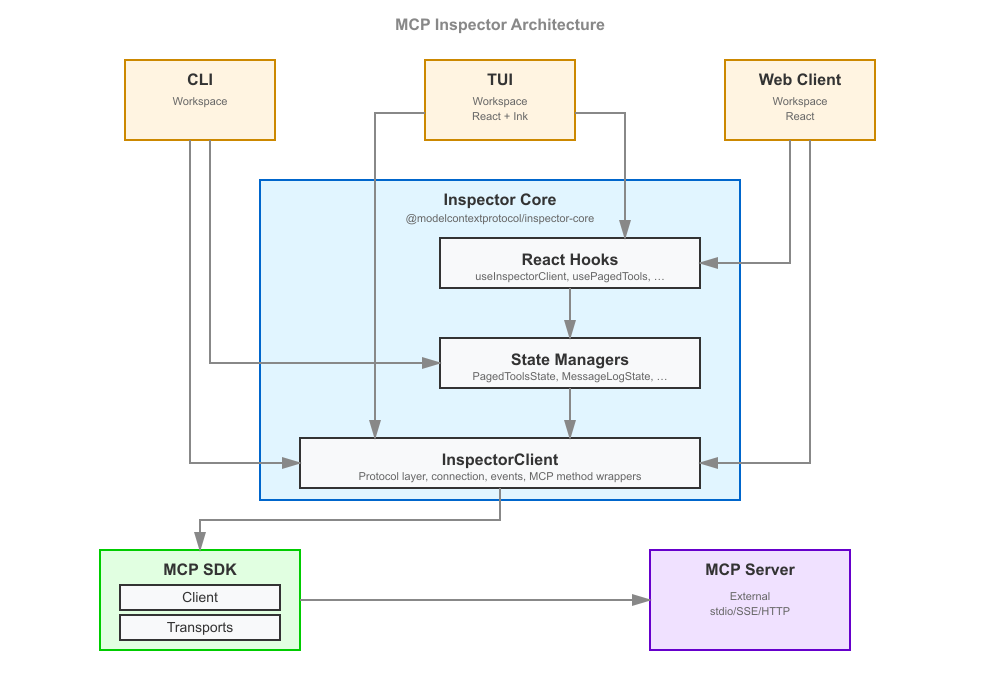
core/ holds the logic shared by all three clients so that web, CLI, and TUI behave identically. Its entry point is the InspectorClient class (core/mcp/), which owns the connection to an MCP server, the request/response lifecycle, and a set of state stores; core/react/ exposes React hooks over those stores that both the web and TUI (Ink) React trees consume. OAuth (core/auth/) is factored into isomorphic logic plus browser/node/remote backends so the same flows work in the browser, in Node, and against a remote backend.
core/ intentionally has no package.json — it is not published on its own. Each client bundles it in via a @inspector/core alias:
- CLI / TUI:
esbuildOptions.aliasin theirtsup.config.tsmaps@inspector/core→ the repocore/directory, andnoExternal: [/^@inspector\/core/]inlines it into the bundle. - Web: the same alias in
clients/web/vite.config.tsfor the browser app and the Node backend runner.
Publishing core/ as its own package (e.g. for third parties to build on) is deliberately deferred — see issue #1636.
Web client: "dumb components" + Storybook
The v2 web client is built from presentational ("dumb") components — they accept data and callbacks as props and contain only display logic, with no direct data fetching or client state. State comes from the @inspector/core hooks, wired in near the top of the tree. This keeps components isolated, testable, and documentable.
That approach is what makes Storybook first-class here: every screen and element component has a *.stories.tsx file (96+ stories) that renders it against fixture props. Storybook play functions double as interaction tests, run headless in CI (npm run ci:storybook, Chromium via Playwright).
Styling follows a strict Mantine-first convention (theme variants and component props over CSS classes, --inspector-* CSS custom properties over raw color literals). The full rules live in AGENTS.md under React instructions — read them before touching web UI. Element components live in clients/web/src/components/elements/; theme variants in clients/web/src/theme/.
Test servers
test-servers/ provides composable MCP servers used by the integration and smoke suites, so tests exercise a real server over a real transport instead of mocks. A server is assembled from presets (fixture factories in test-servers/src/preset-registry.ts — tools, resources, prompts, tasks, elicitation, sampling, OAuth, …) and can be driven two ways:
- In-process — import the factories (
createTestServerHttp,createEchoTool, …) and run the server inside the test's event loop (used by the HTTP integration paths). - As a subprocess —
test-servers/build/test-server-stdio.jsis spawned as a real stdio child (used by the CLI smoke and stdio integration tests).
Configure a server declaratively with a JSON config (see test-servers/configs/*.json) selecting presets, then load it via --config. Because the servers are spawned as real subprocesses, the build output must exist first:
npm run test-servers:build # (from clients/web) → tsc -p test-servers, emits test-servers/build/
The Vite alias @modelcontextprotocol/inspector-test-server (in clients/web/vite.config.ts) points at test-servers/build/index.js so getTestMcpServerPath() resolves to a real .js path.
A streamable-HTTP server can also serve the modern (2026-07-28) protocol era via the SDK's createMcpHandler — set transport.modern in the JSON config (true for dual-era stateless serving, or { "legacy": "reject" } for modern-only strict), or pass modern on the ServerConfig for an in-process createTestServerHttp. This is what lets an Inspector connection negotiating protocolEra: "auto" | "modern" reach the modern leg (populated server/discover, sessionless). See test-servers/configs/modern-http.json. test-servers/configs/modern-mrtr-http.json additionally serves the mrtr_confirm tool (preset mrtr_confirm, createMrtrTool) over the modern leg: its handler returns inputRequired(...) embedding a form elicitation, so invoking it produces a real MRTR round-trip (input_required → the client fulfils the embedded elicitation and retries with a new id → complete). The Inspector drives MRTR manually (inputRequired: { autoFulfill: false }), so the embedded elicitation pauses at the pending-request modal (tagged "input_required") for you to answer, then the retry completes — useful for eyeballing both that pending-request UX and the Protocol view's MRTR conversation grouping. test-servers/configs/mrtr-showcase-http.json bundles every MRTR preset in one modern server for manual testing: mrtr_confirm (single round), mrtr_two_step (two elicitation rounds via requestState), mrtr_sample (embedded sampling → the Sampling panel), mrtr_roots (embedded roots/list, auto-answered silently from configured roots — no modal), mrtr_edge (an inputRequests-only round then a requestState-only round), and mrtr_loop (never completes → the MRTR_MAX_ROUNDS bound trips). (The legacy collect_elicitation preset calls server.elicitInput, which errors on the 2026-07-28 leg — server→client requests aren't allowed there; MRTR is the modern replacement.)
test-servers/configs/modern-network-http.json is the Network-tab showcase for the standardized HTTP headers and new error taxonomy (SEP-2243 / SEP-2575). It serves a get_weather tool whose city argument carries an x-mcp-header: "City" annotation (so a modern client mirrors it to Mcp-Param-City), plus four trigger_* tools that the modern leg's spec-error injector (transport.modern.injectSpecErrors: true) answers with a real HTTP status + JSON-RPC error body: trigger_header_mismatch → 400 / -32020, trigger_missing_capability → 400 / -32021, trigger_unsupported_version → 400 / -32022 (with data.supported), trigger_method_not_found → 404 / -32601. Connect to it with Protocol Era = Modern and open the Network tab to see the mirrored Mcp-* headers highlighted, sentinel values decoded, and each error rendered distinctly. Note: Mcp-Param-* mirroring is skipped by the SDK in the browser (detectProbeEnvironment() !== "browser"), so calling get_weather from the web client omits Mcp-Param-City and the strict server answers -32020 — the same tool is callable from the Node CLI/TUI, where mirroring is active.
test-servers/configs/xmcpheader-modern-http.json is the x-mcp-header Tools-tab showcase (#1632). It serves echo, a get_weather tool with a valid x-mcp-header: "City" annotation on its city argument, an invalid_header_tool whose annotation uses the header name "Bad Header" (a space makes it an invalid RFC 9110 token, so the whole tool definition is invalid), and a trigger_invalid_params tool that the modern leg's spec-error injector (transport.modern.injectSpecErrors: true) answers with a real -32602 Invalid params JSON-RPC error whose message is not about a missing tool. Connect with Protocol Era = Modern and open the Tools tab: get_weather's detail panel shows a "Mirrored request headers (SEP-2243)" section (city → Mcp-Param-City), and invalid_header_tool appears struck-through under an "Excluded (SEP-2243)" divider in the sidebar with the reason on hover (a conforming Streamable HTTP client MUST drop it from tools/list; the Inspector surfaces why). Under SDK v2 a tools/call that rejects with -32602 now renders as a distinct error panel rather than an isError result — headed "Unknown Tool" when the message names a missing tool (reproduce by calling a tool the server dropped from its list), or "Invalid Parameters" for any other -32602 (run trigger_invalid_params).
test-servers/configs/pagination-http.json is the page-by-page fetch showcase (#1721). It serves 12 tools, 12 resources, and 12 prompts (presets numbered_tools / numbered_resources / numbered_prompts, count: 12) with maxPageSize of 4 for each, so every list paginates into three pages. Turn on "Fetch Lists One Page at a Time" (Server Settings — the paginatedLists setting, or the Paginated switch in a list sidebar) and the Tools/Resources/Prompts lists load page 1 only (4 items) with a Load next page control and an N pages loaded status; each click fetches the next 4 and appends them, and Refresh resets to page 1. With the switch off (the default), the same lists auto-aggregate all three pages on connect.
test-servers/configs/advertised-extensions-http.json is the advertised-extensions showcase (#1739). It serves echo (always) and a get_weather tool that is gated on the io.modelcontextprotocol/tasks extension (extensionGatedTools): the tool is registered but starts disabled, and the server enables it on notifications/initialized only when the connected client declared that extension in its capabilities.extensions. Connect (the Inspector advertises the Tasks extension by default) and the Tools list shows both echo and get_weather. Open Server Settings → Advertised Extensions, uncheck Tasks (io.modelcontextprotocol/tasks), and reconnect: the client now advertises no extensions, the server never enables get_weather, and the Tools list shows only echo. This demonstrates the debugging knob — a server legitimately changing tool registration on what the client advertises. (Legacy stateful leg only; the modern per-request leg has no persistent oninitialized.)
test-servers/configs/logging-legacy-http.json and test-servers/configs/logging-modern-http.json are the logging era-fork showcase (#1629). Both serve logging: true plus a send_notification tool that emits a notifications/message at a chosen level; the legacy one is a plain streamable-HTTP server (logging/setLevel era) and the modern one sets transport.modern: true. Connect to the legacy server and open the Logs tab to get the session-scoped Set Active Level selector + Set button; calling send_notification streams the log into the panel. Connect to the modern one with Protocol Era = Modern and the same tab instead shows the Log Level per Request control — pick a level to opt in and the client stamps _meta["io.modelcontextprotocol/logLevel"] on every subsequent request (verify in the Network tab's request body); calling send_notification then streams the log into the panel over the request's SSE response. Set the control back to Off and the same call is silently gated — the request omits the logLevel key, so the log never arrives. That gating is faithful to the spec ("a server MUST NOT emit notifications/message for a request that didn't opt in") because send_notification emits through the SDK's request-scoped, threshold-aware extra.log (ctx.mcpReq.log): on the modern leg it reads the per-request logLevel opt-in from the request envelope and drops the message when the client didn't opt in or the level is below the requested severity; on legacy it honors the session level from logging/setLevel. Because it emits through the request's notify, the modern response upgrades to SSE and the log rides the originating request's stream.
test-servers/configs/subscriptions-legacy-http.json and test-servers/configs/subscriptions-modern-http.json are the resource-subscription era-fork showcase (#1630). Both serve three numbered_resources with subscriptions: true; the legacy one also serves an update_resource tool, and the modern one sets transport.modern: true. Connect to the legacy server, open a resource in the Resources tab and click Subscribe — the client sends resources/subscribe (Network/Protocol view) and the Subscriptions section lists the URI with no stream chrome; call update_resource with that URI and the server updates the content and emits notifications/resources/updated, stamping the subscribed tile's last-updated time. Connect to the modern server with Protocol Era = Modern and the same Subscribe instead sends subscriptions/listen (its filter carries resourceSubscriptions + the resourcesListChanged opt-in) and resolves on notifications/subscriptions/acknowledged; the Subscriptions section then shows the stream-status badge (Connecting… → Listening) in its header, and if the long-lived stream drops it reconnects by re-listing. The modern config deliberately omits update_resource: the SDK's modern leg is stateless/per-request (createMcpHandler(() => createMcpServer(config))), so the tool would run against a throwaway server instance — the content change wouldn't persist for the next resources/read, and its resources/updated wouldn't reach the (separate) listen stream — which is more confusing than useful. The live update-notification round-trip is therefore demonstrated on the legacy (stateful-session) server; the modern server is for the subscribe/listen/badge behavior. (The Inspector's receive path is era-transparent, so a real stateful modern server that routes resources/updated onto the listen stream drives the subscribed tile the same way.)
test-servers/configs/tasks-legacy-http.json and test-servers/configs/tasks-modern-http.json are the Tasks era-fork showcase (#1631). The legacy server advertises capabilities.tasks (tasks: { list, cancel }) with the simple_task / progress_task / elicitation_task presets — connect to it, run one of those tools with Run as task on, and the Tasks tab lists it (populated via tasks/list), polls tasks/get, fetches the payload with the blocking tasks/result, and cancels with tasks/cancel. The modern server sets transport.modern: true and tasksExtension: true, advertising the io.modelcontextprotocol/tasks extension (SEP-2663) and serving the modern_task / modern_input_task tools. Connect with Protocol Era = Modern: the Tasks tab is now gated on the negotiated extension (not capabilities.tasks). Run modern_task as a task — the tools/call returns a CreateTaskResult (resultType: "task", visible in the Protocol/Network tabs), the client polls tasks/get (no tasks/list), and the completed task inlines its result (no blocking tasks/result). Run modern_input_task and the task moves to input_required, surfacing an embedded elicitation through the pending-request modal; answering it sends tasks/update with the inputResponses, and the next poll completes. SDK v2 removed all tasks support and era-gates the tasks/* spec methods out of the modern era on both sides — so the Inspector drives the extension itself (the resultType: "task" frame is rewritten at the transport into a CallToolResult carrying the handle; tasks/get/update/cancel ride a raw-wire request channel with the full modern envelope), and the test server serves tasks/* from an Express interceptor ahead of the SDK handler (the SDK's modern leg would answer them -32601). The Tasks tab's Refresh re-polls the handles already known to the client (modern has no server-side task list).
Building
npm run build # builds all clients: web → cli → tui → launcher
Individual clients: build:web, build:cli, build:tui, build:launcher. The web build produces both the browser SPA (clients/web/dist, Vite) and the Node prod-server runner (clients/web/build, tsup).
Testing & the quality gate
Each client self-validates from its own folder; the root scripts chain them. There is no aggregate root test script — use validate (fast) or coverage (the gate).
| Script | What it does |
|---|---|
npm run validate |
Runs verify:format-coverage (asserts every tracked source file is format-gated) first, then validate:core (the shared core/ format:check + lint gate), then per client: format:check + lint + typecheck (cli/tui only) + build + fast unit tests. The quick inner-loop check. |
npm run coverage |
The per-file ≥90% gate (lines/statements/functions/branches) under v8 instrumentation, per client. CI-enforced. For web this also runs the integration project and covers the shared core/ runtime (including core/json and core/client). |
npm run smoke |
End-to-end smokes through the built launcher (--help dispatch + prod cli/tui/web), plus a headless-Chromium boot smoke that runs the prod web bundle and asserts a clean first render (no uncaught error — sync exception or unhandled rejection, how a Node built-in reaching the browser bundle manifests). |
npm run verify:build-gate |
Runs a real vite build with a Node built-in forced into the browser graph and asserts the build fails via the #1769 gate (which turns Vite's browser-externalization warning into a hard error). Guards against the warning phrasing drifting in a Vite bump and silently disabling the gate. Part of npm run ci. |
npm run verify:format-coverage |
Parses the format:check globs out of every package.json (only those reachable from validate), enumerates all tracked source files, and fails listing any not covered by a glob — the durable guard for the "every first-party source file is format-gated" invariant (#1792). Runs first in validate. |
npm run test:scripts |
Table-driven unit tests (node --test) for the guard's own pure parsers (scripts/lib/npm-scripts.mjs + the exported helpers of verify-typecheck-coverage.mjs), one case per rule they encode. Runs in validate — and verify:typecheck-coverage guards this gate in turn (reachable from validate, non-empty test set, every test file matched by the test:scripts glob), since node --test silently skips a file its glob misses and still exits 0. |
npm run verify:typecheck-coverage |
The typecheck-coverage analog of the above (#1791): for each Node client (auto-discovered from disk — enrolled via its typecheck script's projects, or for a tsc -b client like clients/web via its tsconfig.json references) it runs those projects with tsc --listFilesOnly, unions them, and fails listing any tracked .ts/.tsx/.mts/.cts under the client that lands in no project (so a new top-level config/helper can't silently go untypechecked). It also requires, deny-by-default, the first-party TS no client owns (test-servers/src, the root vitest.shared.mts, all of core/, and any new top-level location) to land in some client project's tsc pass — so a core *.tsx web's projects don't reach is caught too. Also asserts the gate is wired (each client's typecheck pass — its typecheck script, or web's tsc -b — is reachable from its validate, and the root chain runs each client's validate). Runs in validate. |
npm run ci |
Mandatory pre-push command. validate → coverage → verify:build-gate → smoke → Storybook. A true superset of GitHub CI. |
npm run pack:verify |
Publish smoke — see Publishing. |
Per-client scripts exist too (validate:web, coverage:cli, smoke:tui, …), plus root validate:core / format:core for the shared core/ package, format:scripts for the root scripts/ tooling, and format:shared / lint:shared for the root "shared" surface (test-servers/src/**, vitest.shared.mts, the root eslint.config.js). Run npm run format before committing — the root format fixes core/, the root scripts/, the shared surface, and every client; validate runs the non-fixing format:check and fails CI on any unformatted file.
For the full testing rules — the ≥90% per-file gate, where test files live, the unit vs. integration vs. storybook projects, and the v8 ignore policy — see AGENTS.md.
Publishing
The root @modelcontextprotocol/inspector package ships as one tarball with a single version number — no separate -web / -cli / -tui / -core packages. npm run build builds every client, then prepack runs before npm publish. Runtime dependencies are declared on the root package.json; client builds bundle @inspector/core and externalize npm packages resolved from the root install.
What ships, and the packaging invariants
The root package.json "files" allowlist is the source of truth for the tarball. A few non-obvious entries exist because they are read at runtime or were silently dropped by npm's packlist — do not remove them without re-running npm run pack:verify:
- No source maps. The client bundlers set
sourcemap: false(clients/{cli,tui}/tsup.config.ts,clients/web/tsup.runner.config.ts); Vite and the launcher'stscalready emit none. Maps are ~half the unpacked size and aren't needed at runtime — debug vianpm run devon the source. clients/web/buildships viaclients/web/.npmignore.clients/web/.gitignorelistsbuild/, and npm's packlist honors that nested.gitignoreover the root"files"allowlist — so the prod web-server runner was silently missing from the tarball whileclients/web/distslipped through (its.gitignoreonly listsdist-ssr).clients/web/.npmignoreoverrides the.gitignorefor publishing so bothbuild/(runner) anddist/(SPA) ship. The other clients don't need this — none ship a nested.gitignore.- A single version number, read from the root
package.json. The Inspector ships as one package with one version, so only the rootpackage.jsoncarries aversion— the fourclients/*/package.jsons deliberately have none. Every Node client (CLI, TUI, and the web backend) resolves the version through the sharedreadInspectorVersion()reader incore/node/version.ts, which walks up to the root manifest (always present in the tarball). No clientpackage.jsonis read at runtime, so none needs to ship. The web browser can't read the filesystem; it gets its version from the backend viaGET /api/config(see #1639).
npm run pack:verify — publish smoke against the real tarball
The smoke:* scripts run against the in-repo build tree, which is not the published package. npm run pack:verify (scripts/pack-and-verify.mjs) closes that gap: it builds, npm packs the publishable tarball (asserting no source maps ship and that the runtime-required files are present), installs the tarball into a clean throwaway consumer — a fresh temp directory where it runs a real npm install <tgz> (pulls runtime deps, runs postinstall), exactly as npx @modelcontextprotocol/inspector would — and drives the installed mcp-inspector bin end to end: --help dispatch, a real --cli tools/list over stdio, and a prod --web boot that must serve / from the shipped dist. It catches "works in --dev, breaks under npx …" path/packaging failures. It requires network access (the install pulls deps), so it is a local / release check, not part of the fast validate/ci loop.
Cutting a release
Publishing is automated by two release-gated jobs in .github/workflows/main.yml (github.event_name == 'release', both needs: build):
publish— the npm package. Runsnpm run pack:verifyas the pre-publish gate, asserts the release tag matches the rootpackage.jsonversion, thennpm publish --access public --provenance— a singlenpm publish(v2 is not an npm workspace, so there is no v1-stylepublish-all/--workspaces), with a signed provenance attestation via GitHub OIDC (id-token: write,environment: release,NPM_TOKEN).publish-github-container-registry— the container image (see Docker).
Because there is one version number (only the root package.json has one — the clients carry none, so there is nothing to keep in sync and no check-version step), the release flow is just:
npm version <major|minor|patch>   # bumps the root package.json + tags
git push --follow-tags
# then draft & publish a GitHub Release for that tag → triggers `publish`
The release's target commit selects which workflow runs, so this only publishes when a release is cut from a commit carrying this (v2) workflow.
Docker
A container image is published to GHCR (ghcr.io/modelcontextprotocol/inspector, linux/amd64 + linux/arm64) by the release workflow. The Dockerfile is a two-stage build: the first stage installs and npm packs the publishable tarball; the second stage npm install -gs that tarball, so the image ships the exact same artifact as npm, with a clean mcp-inspector bin.
# run the web UI (reads the auth token from the container logs)
docker run --rm -p 6274:6274 ghcr.io/modelcontextprotocol/inspector

# or build the image locally
docker build -t mcp-inspector .
docker run --rm -p 6274:6274 mcp-inspector
The image defaults to --web bound to 0.0.0.0:6274 with browser auto-open disabled; override the args to run another mode (docker run --rm ghcr.io/modelcontextprotocol/inspector --cli …). Pass -e MCP_INSPECTOR_API_TOKEN=… to set a known token (otherwise one is generated and printed in the logs), or -e DANGEROUSLY_OMIT_AUTH=true to disable auth. Binding 0.0.0.0 (all network interfaces) is refused by default outside a container — it exposes the process-spawning backend to the local network — so the image opts in explicitly with DANGEROUSLY_BIND_ALL_INTERFACES=true (already set in the Dockerfile); a bare HOST=0.0.0.0 without that flag exits with an error. If you remap the published port (-p 8080:6274), the browser's origin (http://localhost:8080) no longer matches the in-container port, so set -e ALLOWED_ORIGINS=http://localhost:8080,http://127.0.0.1:8080 (or run -e CLIENT_PORT=8080 -p 8080:8080) or connects will 403. ALLOWED_ORIGINS replaces the default list rather than merging, so list every loopback form you'll browse from (see the web README). The image runs as the non-root node user and has a HEALTHCHECK that probes the web UI — it assumes the default --web mode, so add --no-healthcheck when running --cli/--tui (which have no web server).
Contributing — AGENTS.md and CLAUDE.md
AGENTS.md is the contract for changing this codebase, and it applies to humans and AI agents alike. It is not agent-only boilerplate — it holds the project's real conventions: the issue-and-board workflow, branch/label rules, the TypeScript and Mantine/React standards, the testing and coverage requirements, and the mandatory pre-push gate. Read it before making changes, and keep it up to date when you change structure, tooling, or rules.
CLAUDE.md is the entry point the Claude Code agent loads automatically; it simply includes AGENTS.md and this README, so both agents and humans work from the same source of truth. If you use a different agent that reads AGENTS.md, you get the same rules.
A key rule worth surfacing here: all work is issue-driven. Before starting, find or create a tracking issue on the v2 project board; open PRs against v2/main with Closes #<issue>. The exact recipes (labels, board IDs, statuses) are in AGENTS.md.
License
MIT.