- TypeScript 90.8%
- JavaScript 8.8%
- CSS 0.2%
- HTML 0.2%
| Filename | Latest commit message | Latest commit date |
|---|---|---|
 b3b04c6939
Some checks failed
Run install, format, lint, build, and test on every push / build (push) Has been cancelled
Run install, format, lint, build, and test on every push / publish (push) Has been cancelled
Run install, format, lint, build, and test on every push / publish-github-container-registry (push) Has been cancelled
* Thread cacheMode through managed list refresh via SDK cache-aware verbs (#1721) Manual/auto refresh of tools/resources/prompts now forces a cache-bypassing round trip on modern servers, delivering the raw-request cacheMode control deferred from #1628. The InspectorClient list/read path uses the SDK's single-page `client.request` verbs (for pagination debugging), which never consult the SDK response cache — so `cacheMode` was inert there. This adds a separate aggregate path that routes through the SDK's cache-aware high-level verbs, where `cacheMode` is honored: - InspectorClient: new `listAllTools/Prompts/Resources/ResourceTemplates( { cacheMode, metadata })` that call `client.listTools()` etc. (all-page aggregate + SEP-2243 x-mcp-header exclusion + cache consult/write). A shared `getCacheableRequestOptions` / `aggregateListParams` back all four. - InspectorClientProtocol: the four `listAll*` methods added. - ManagedListState: delegates page walking to the SDK verb (config `fetchPage` loop → `fetchAll`); `refresh(metadata?, cacheMode?)` threads cacheMode. A `list_changed` auto-refresh bypasses the cache (`cacheMode: "refresh"`). - Managed hooks: user-initiated `refresh()` passes `cacheMode: "refresh"`, so the existing per-tab Refresh buttons become genuinely cache-bypassing — no App wiring change. Connect-time load stays default (`'use'`). The single-page `listTools(cursor)` primitive is unchanged; the paged hooks still surface per-page `nextCursor`. Co-Authored-By: Claude Opus 4.8 (1M context) <noreply@anthropic.com> Claude-Session: https://claude.ai/code/session_01XNdjEPKLG637X8YmhDiEk5 * Single-page list pagination: sidebar toggle + server setting (#1721) Delivers the deferred single-page fetch UI: Tools/Resources/Prompts can be loaded one page at a time instead of auto-aggregating every page — a defensive option for servers with very large lists. - New `singlePageLists` server setting (persisted, server-wide), plumbed through ServerConfig/InspectorServerSettings, serverList convert/default, the node + remote settings paths, and the Server Settings form ("Fetch Lists One Page at a Time"). - New `ListPaginationControls` element (a "Single page" switch + "Load next page" button + "N pages loaded" status) rendered in each list sidebar; the toggle edits the setting live (optimistic) and persists it. - The paged state stores (PagedTools/Prompts/ResourcesState) now own loading: they auto-load page 1 on connect in single-page mode and track nextCursor + page count as observable state; the managed stores skip their all-page walk in single-page mode (so nothing is over-fetched) while still lighting the list-changed indicator. `usePaginatedList` selects the display source and pagination controls per mode — pure, no data-loading in React effects. - Refresh is mode-aware: reload page 1 in single-page mode, refetch the whole aggregate otherwise. Sidebars widened 340→360 so the controls don't crowd list entries. - Test server: `test-servers/configs/pagination-http.json` (12 tools/resources/ prompts, page size 4 → 3 pages each) exercises the flow end to end. Co-Authored-By: Claude Opus 4.8 (1M context) <noreply@anthropic.com> Claude-Session: https://claude.ai/code/session_01XNdjEPKLG637X8YmhDiEk5 * Add pr-screenshots proving single-page pagination (#1721) Co-Authored-By: Claude Opus 4.8 (1M context) <noreply@anthropic.com> Claude-Session: https://claude.ai/code/session_01XNdjEPKLG637X8YmhDiEk5 * Address @claude review: template load, double-click guard, auth recovery (#1721) - Fix: resource templates never loaded on connect in single-page mode. The connect-time all-page skip now applies only to lists with a paged counterpart (new `deferInSinglePage` flag on ManagedListConfig; false for resource templates), so templates still aggregate on connect regardless of the setting. - Guard `PagedTools/Prompts/ResourcesState.loadPage` against a concurrent load (fast double-click on "Load next page") so the same page can't be appended twice; the in-flight load owns the cursor and the second call is a no-op. - Thread ambient auth recovery through the single-page refresh, Load-next-page, and mode-switch loads (they previously bypassed it) — usePaginatedList's onRefresh/onLoadMore now return their promises so App can wrap them. - Drop the misleading "aggregated list" wording from the paged-store docs. Tests added for each; npm run coverage green. Co-Authored-By: Claude Opus 4.8 (1M context) <noreply@anthropic.com> Claude-Session: https://claude.ai/code/session_01XNdjEPKLG637X8YmhDiEk5 * Review round 2: revert optimistic toggle when persisting the setting fails (#1721) Non-blocking review follow-up. If updateServerSettings rejects, the optimistic `singlePageListsOverride` is now cleared and the live client setting rolled back (the effect only clears the override when the persisted value changes, which doesn't happen on failure), so the UI and client reflect what's on disk rather than the failed edit. Added an App test for the revert path. Co-Authored-By: Claude Opus 4.8 (1M context) <noreply@anthropic.com> Claude-Session: https://claude.ai/code/session_01XNdjEPKLG637X8YmhDiEk5 * Fix single-page Refresh not clearing list-changed indicator + UI polish (#1721) Round-3 review fix (blocking): in single-page mode a `list_changed` lights the list-changed indicator, but the single-page Refresh reloads page 1 of the paged store and bypassed `useManaged*.refresh()`, so the indicator was never cleared. Expose `clearListChanged` from useManagedTools/Prompts/Resources and call it in the single-page branch of onRefreshTools/Prompts/Resources. Tests added. UI polish (user feedback on the sidebar control): - Rename the switch label "Single page" → "Paginated". - Put "Load next page" on the same row as the switch, space-between (switch fully left, button fully right). - Move the "N pages loaded" status to its own line below the row, centered. - Hide the whole control once the list is known to be a single page (single-page mode, page 1 loaded, no nextCursor) — nothing to paginate. pr-screenshots refreshed to the new layout. Co-Authored-By: Claude Opus 4.8 (1M context) <noreply@anthropic.com> Claude-Session: https://claude.ai/code/session_01XNdjEPKLG637X8YmhDiEk5 * Rename the singlePageLists setting to paginatedLists for clarity (#1721) `singlePageLists` read backwards from the "Paginated" switch label (it sounds like paginated=false). Rename the server setting to `paginatedLists` with the same value meaning — true = paginated/one-page-at-a-time, false = aggregate-all — and follow through on the related identifiers for consistency: - Setting field `paginatedLists` across ServerConfig / InspectorServerSettings, serverList convert/default, node + remote settings paths, and the form/modal callbacks (onPaginatedListsChange). - `usePaginatedList` / `ListPaginationControls` prop `singlePage` → `paginated`, `onSinglePageChange` → `onPaginatedChange`. - `ManagedListConfig.deferInSinglePage` → `deferWhenPaginated`. - App state (paginatedListsOverride, onTogglePaginatedLists, …) and all tests/fixtures + mode-referring comments. "single-page" wording that denotes the SDK's one-page `client.request` verb (inspectorClient) is intentionally left as-is. Purely a rename — no behavior change; unit + integration + cli + tui + coverage all green. Co-Authored-By: Claude Opus 4.8 (1M context) <noreply@anthropic.com> Claude-Session: https://claude.ai/code/session_01XNdjEPKLG637X8YmhDiEk5 * Format App.test.tsx (prettier) after the paginatedLists rename (#1721) Co-Authored-By: Claude Opus 4.8 (1M context) <noreply@anthropic.com> Claude-Session: https://claude.ai/code/session_01XNdjEPKLG637X8YmhDiEk5 --------- Co-authored-by: Claude Opus 4.8 (1M context) <noreply@anthropic.com> |
||
| .claude | ||
| .github/workflows | ||
| clients | ||
| core | ||
| docs | ||
| pr-screenshots | ||
| scripts | ||
| specification | ||
| test-servers | ||
| .dockerignore | ||
| .gitignore | ||
| .npmignore | ||
| AGENTS.md | ||
| CLAUDE.md | ||
| Dockerfile | ||
| package-lock.json | ||
| package.json | ||
| README.md | ||
| tsconfig.base.json | ||
| vitest.shared.mts | ||
MCP Inspector
A developer tool for inspecting Model Context Protocol (MCP) servers. It ships as a single package, @modelcontextprotocol/inspector, that provides three ways to inspect a server:
- Web — a Vite + React + Mantine single-page app with a Node backend.
- CLI — a scriptable command-line client for automation, CI, and fast agent feedback loops.
- TUI — an interactive terminal UI built with Ink.
All three run through one global mcp-inspector binary:
npx @modelcontextprotocol/inspector          # web UI (default)
npx @modelcontextprotocol/inspector --cli    # CLI
npx @modelcontextprotocol/inspector --tui    # TUI
Repo status. This is the v2 line of the Inspector (branch
v2/main). Themainbranch is the legacy v1 implementation (bug fixes only). v2 will eventually replacemain. SeeAGENTS.mdfor branch/board conventions.
Project layout
v2 is not an npm workspace. Each client under clients/* keeps its own package.json and node_modules; shared code lives in core/ and is consumed via a @inspector/core build-time alias (no package.json of its own). A single npm install at the root cascades installs into every client (see Setup).
inspector/
├── clients/
│   ├── web/          # Web client (Vite + React + Mantine). src/ = browser app; server/ = Node dev/prod backend
│   ├── cli/          # CLI client (tsup bundle, @inspector/core alias)
│   ├── tui/          # TUI client (Ink + React, tsup bundle)
│   └── launcher/     # Shared launcher — provides the `mcp-inspector` bin, dispatches to web/cli/tui
├── core/             # Shared code consumed via the `@inspector/core` alias (no package.json)
│   ├── auth/         # OAuth: providers, discovery, storage, mid-session recovery (browser/node/remote backends)
│   ├── json/         # JSON + parameter/argument conversion utilities
│   ├── logging/      # Silent pino logger singleton
│   ├── mcp/          # InspectorClient runtime, state stores, transports, config import
│   ├── react/        # React hooks over the state stores
│   └── storage/      # File I/O helpers for the OAuth persist backends
├── test-servers/     # Composable MCP test servers + fixtures used by integration tests
├── scripts/          # Root build/verify tooling (install cascade, smokes, pack:verify)
├── specification/    # Design/build specifications
├── AGENTS.md         # Contribution rules for agents AND humans (see below)
└── README.md         # You are here
Each client has its own README with client-specific detail: web · cli · tui · launcher.
Task-oriented guides live under docs/ — see Reviewing an MCP App, the CLI-first → one-shot-web recipe for automated App-tool review: --app-info probe → deep-link navigate → rendered widget, plus OAuth handoff and proxy support.
Setup
Requires Node >=22.19.0.
npm install # root install; postinstall cascades into every client
- Fresh clone: run
npm installat the repo root. - After a pull that changes a client's dependencies: re-run
npm installat the root to re-sync every client.
The cascade (scripts/install-clients.mjs) is dev-only — it exits early when the package is installed as a dependency, and the published tarball ships only each client's build/, so end users are unaffected. Set INSPECTOR_SKIP_CLIENT_INSTALL=1 to skip it.
Running during development
For day-to-day web iteration, run Vite directly from the web client (fast HMR, no launcher build needed):
cd clients/web && npm run dev
The launcher-driven scripts below run the built launcher, so build first (npm run build):
npm run web        # prod web launcher against clients/web/dist
npm run web:dev    # web launcher in --dev mode (Vite)
The @inspector/core shared package
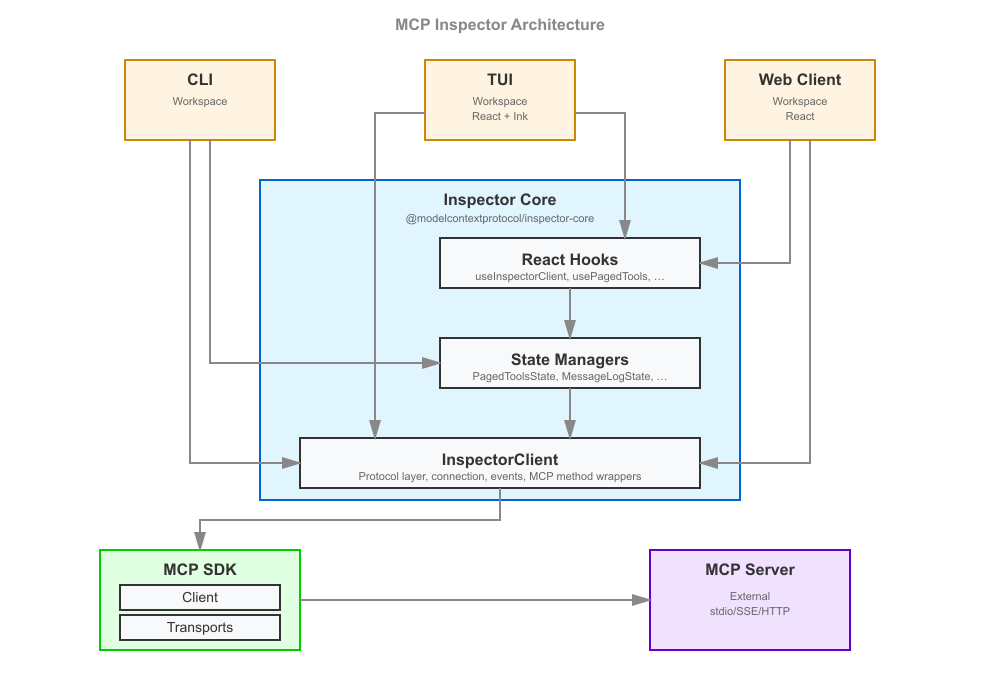
core/ holds the logic shared by all three clients so that web, CLI, and TUI behave identically. Its entry point is the InspectorClient class (core/mcp/), which owns the connection to an MCP server, the request/response lifecycle, and a set of state stores; core/react/ exposes React hooks over those stores that both the web and TUI (Ink) React trees consume. OAuth (core/auth/) is factored into isomorphic logic plus browser/node/remote backends so the same flows work in the browser, in Node, and against a remote backend.
core/ intentionally has no package.json — it is not published on its own. Each client bundles it in via a @inspector/core alias:
- CLI / TUI:
esbuildOptions.aliasin theirtsup.config.tsmaps@inspector/core→ the repocore/directory, andnoExternal: [/^@inspector\/core/]inlines it into the bundle. - Web: the same alias in
clients/web/vite.config.tsfor the browser app and the Node backend runner.
Publishing core/ as its own package (e.g. for third parties to build on) is deliberately deferred — see issue #1636.
Web client: "dumb components" + Storybook
The v2 web client is built from presentational ("dumb") components — they accept data and callbacks as props and contain only display logic, with no direct data fetching or client state. State comes from the @inspector/core hooks, wired in near the top of the tree. This keeps components isolated, testable, and documentable.
That approach is what makes Storybook first-class here: every screen and element component has a *.stories.tsx file (96+ stories) that renders it against fixture props. Storybook play functions double as interaction tests, run headless in CI (npm run ci:storybook, Chromium via Playwright).
Styling follows a strict Mantine-first convention (theme variants and component props over CSS classes, --inspector-* CSS custom properties over raw color literals). The full rules live in AGENTS.md under React instructions — read them before touching web UI. Element components live in clients/web/src/components/elements/; theme variants in clients/web/src/theme/.
Test servers
test-servers/ provides composable MCP servers used by the integration and smoke suites, so tests exercise a real server over a real transport instead of mocks. A server is assembled from presets (fixture factories in test-servers/src/preset-registry.ts — tools, resources, prompts, tasks, elicitation, sampling, OAuth, …) and can be driven two ways:
- In-process — import the factories (
createTestServerHttp,createEchoTool, …) and run the server inside the test's event loop (used by the HTTP integration paths). - As a subprocess —
test-servers/build/test-server-stdio.jsis spawned as a real stdio child (used by the CLI smoke and stdio integration tests).
Configure a server declaratively with a JSON config (see test-servers/configs/*.json) selecting presets, then load it via --config. Because the servers are spawned as real subprocesses, the build output must exist first:
npm run test-servers:build # (from clients/web) → tsc -p test-servers, emits test-servers/build/
The Vite alias @modelcontextprotocol/inspector-test-server (in clients/web/vite.config.ts) points at test-servers/build/index.js so getTestMcpServerPath() resolves to a real .js path.
A streamable-HTTP server can also serve the modern (2026-07-28) protocol era via the SDK's createMcpHandler — set transport.modern in the JSON config (true for dual-era stateless serving, or { "legacy": "reject" } for modern-only strict), or pass modern on the ServerConfig for an in-process createTestServerHttp. This is what lets an Inspector connection negotiating protocolEra: "auto" | "modern" reach the modern leg (populated server/discover, sessionless). See test-servers/configs/modern-http.json. test-servers/configs/modern-mrtr-http.json additionally serves the mrtr_confirm tool (preset mrtr_confirm, createMrtrTool) over the modern leg: its handler returns inputRequired(...) embedding a form elicitation, so invoking it produces a real MRTR round-trip (input_required → the client fulfils the embedded elicitation and retries with a new id → complete). The Inspector drives MRTR manually (inputRequired: { autoFulfill: false }), so the embedded elicitation pauses at the pending-request modal (tagged "input_required") for you to answer, then the retry completes — useful for eyeballing both that pending-request UX and the Protocol view's MRTR conversation grouping. test-servers/configs/mrtr-showcase-http.json bundles every MRTR preset in one modern server for manual testing: mrtr_confirm (single round), mrtr_two_step (two elicitation rounds via requestState), mrtr_sample (embedded sampling → the Sampling panel), mrtr_roots (embedded roots/list, auto-answered silently from configured roots — no modal), mrtr_edge (an inputRequests-only round then a requestState-only round), and mrtr_loop (never completes → the MRTR_MAX_ROUNDS bound trips). (The legacy collect_elicitation preset calls server.elicitInput, which errors on the 2026-07-28 leg — server→client requests aren't allowed there; MRTR is the modern replacement.)
test-servers/configs/modern-network-http.json is the Network-tab showcase for the standardized HTTP headers and new error taxonomy (SEP-2243 / SEP-2575). It serves a get_weather tool whose city argument carries an x-mcp-header: "City" annotation (so a modern client mirrors it to Mcp-Param-City), plus four trigger_* tools that the modern leg's spec-error injector (transport.modern.injectSpecErrors: true) answers with a real HTTP status + JSON-RPC error body: trigger_header_mismatch → 400 / -32020, trigger_missing_capability → 400 / -32021, trigger_unsupported_version → 400 / -32022 (with data.supported), trigger_method_not_found → 404 / -32601. Connect to it with Protocol Era = Modern and open the Network tab to see the mirrored Mcp-* headers highlighted, sentinel values decoded, and each error rendered distinctly. Note: Mcp-Param-* mirroring is skipped by the SDK in the browser (detectProbeEnvironment() !== "browser"), so calling get_weather from the web client omits Mcp-Param-City and the strict server answers -32020 — the same tool is callable from the Node CLI/TUI, where mirroring is active.
test-servers/configs/pagination-http.json is the page-by-page fetch showcase (#1721). It serves 12 tools, 12 resources, and 12 prompts (presets numbered_tools / numbered_resources / numbered_prompts, count: 12) with maxPageSize of 4 for each, so every list paginates into three pages. Turn on "Fetch Lists One Page at a Time" (Server Settings — the paginatedLists setting, or the Paginated switch in a list sidebar) and the Tools/Resources/Prompts lists load page 1 only (4 items) with a Load next page control and an N pages loaded status; each click fetches the next 4 and appends them, and Refresh resets to page 1. With the switch off (the default), the same lists auto-aggregate all three pages on connect.
Building
npm run build # builds all clients: web → cli → tui → launcher
Individual clients: build:web, build:cli, build:tui, build:launcher. The web build produces both the browser SPA (clients/web/dist, Vite) and the Node prod-server runner (clients/web/build, tsup).
Testing & the quality gate
Each client self-validates from its own folder; the root scripts chain them. There is no aggregate root test script — use validate (fast) or coverage (the gate).
| Script | What it does |
|---|---|
npm run validate |
format:check + lint + build + fast unit tests, per client. The quick inner-loop check. |
npm run coverage |
The per-file ≥90% gate (lines/statements/functions/branches) under v8 instrumentation, per client. CI-enforced. For web this also runs the integration project. |
npm run smoke |
End-to-end smokes through the built launcher (--help dispatch + prod cli/tui/web). |
npm run ci |
Mandatory pre-push command. validate → coverage → smoke → Storybook. A true superset of GitHub CI. |
npm run pack:verify |
Publish smoke — see Publishing. |
Per-client scripts exist too (validate:web, coverage:cli, smoke:tui, …). Run npm run format (per client) before committing — validate runs the non-fixing format:check and fails CI on any unformatted file.
For the full testing rules — the ≥90% per-file gate, where test files live, the unit vs. integration vs. storybook projects, and the v8 ignore policy — see AGENTS.md.
Publishing
The root @modelcontextprotocol/inspector package ships as one tarball with a single version number — no separate -web / -cli / -tui / -core packages. npm run build builds every client, then prepack runs before npm publish. Runtime dependencies are declared on the root package.json; client builds bundle @inspector/core and externalize npm packages resolved from the root install.
What ships, and the packaging invariants
The root package.json "files" allowlist is the source of truth for the tarball. A few non-obvious entries exist because they are read at runtime or were silently dropped by npm's packlist — do not remove them without re-running npm run pack:verify:
- No source maps. The client bundlers set
sourcemap: false(clients/{cli,tui}/tsup.config.ts,clients/web/tsup.runner.config.ts); Vite and the launcher'stscalready emit none. Maps are ~half the unpacked size and aren't needed at runtime — debug vianpm run devon the source. clients/web/buildships viaclients/web/.npmignore.clients/web/.gitignorelistsbuild/, and npm's packlist honors that nested.gitignoreover the root"files"allowlist — so the prod web-server runner was silently missing from the tarball whileclients/web/distslipped through (its.gitignoreonly listsdist-ssr).clients/web/.npmignoreoverrides the.gitignorefor publishing so bothbuild/(runner) anddist/(SPA) ship. The other clients don't need this — none ship a nested.gitignore.- A single version number, read from the root
package.json. The Inspector ships as one package with one version, so only the rootpackage.jsoncarries aversion— the fourclients/*/package.jsons deliberately have none. Every Node client (CLI, TUI, and the web backend) resolves the version through the sharedreadInspectorVersion()reader incore/node/version.ts, which walks up to the root manifest (always present in the tarball). No clientpackage.jsonis read at runtime, so none needs to ship. The web browser can't read the filesystem; it gets its version from the backend viaGET /api/config(see #1639).
npm run pack:verify — publish smoke against the real tarball
The smoke:* scripts run against the in-repo build tree, which is not the published package. npm run pack:verify (scripts/pack-and-verify.mjs) closes that gap: it builds, npm packs the publishable tarball (asserting no source maps ship and that the runtime-required files are present), installs the tarball into a clean throwaway consumer — a fresh temp directory where it runs a real npm install <tgz> (pulls runtime deps, runs postinstall), exactly as npx @modelcontextprotocol/inspector would — and drives the installed mcp-inspector bin end to end: --help dispatch, a real --cli tools/list over stdio, and a prod --web boot that must serve / from the shipped dist. It catches "works in --dev, breaks under npx …" path/packaging failures. It requires network access (the install pulls deps), so it is a local / release check, not part of the fast validate/ci loop.
Cutting a release
Publishing is automated by two release-gated jobs in .github/workflows/main.yml (github.event_name == 'release', both needs: build):
publish— the npm package. Runsnpm run pack:verifyas the pre-publish gate, asserts the release tag matches the rootpackage.jsonversion, thennpm publish --access public --provenance— a singlenpm publish(v2 is not an npm workspace, so there is no v1-stylepublish-all/--workspaces), with a signed provenance attestation via GitHub OIDC (id-token: write,environment: release,NPM_TOKEN).publish-github-container-registry— the container image (see Docker).
Because there is one version number (only the root package.json has one — the clients carry none, so there is nothing to keep in sync and no check-version step), the release flow is just:
npm version <major|minor|patch>   # bumps the root package.json + tags
git push --follow-tags
# then draft & publish a GitHub Release for that tag → triggers `publish`
The release's target commit selects which workflow runs, so this only publishes when a release is cut from a commit carrying this (v2) workflow.
Docker
A container image is published to GHCR (ghcr.io/modelcontextprotocol/inspector, linux/amd64 + linux/arm64) by the release workflow. The Dockerfile is a two-stage build: the first stage installs and npm packs the publishable tarball; the second stage npm install -gs that tarball, so the image ships the exact same artifact as npm, with a clean mcp-inspector bin.
# run the web UI (reads the auth token from the container logs)
docker run --rm -p 6274:6274 ghcr.io/modelcontextprotocol/inspector

# or build the image locally
docker build -t mcp-inspector .
docker run --rm -p 6274:6274 mcp-inspector
The image defaults to --web bound to 0.0.0.0:6274 with browser auto-open disabled; override the args to run another mode (docker run --rm ghcr.io/modelcontextprotocol/inspector --cli …). Pass -e MCP_INSPECTOR_API_TOKEN=… to set a known token (otherwise one is generated and printed in the logs), or -e DANGEROUSLY_OMIT_AUTH=true to disable auth. The image runs as the non-root node user and has a HEALTHCHECK that probes the web UI — it assumes the default --web mode, so add --no-healthcheck when running --cli/--tui (which have no web server).
Contributing — AGENTS.md and CLAUDE.md
AGENTS.md is the contract for changing this codebase, and it applies to humans and AI agents alike. It is not agent-only boilerplate — it holds the project's real conventions: the issue-and-board workflow, branch/label rules, the TypeScript and Mantine/React standards, the testing and coverage requirements, and the mandatory pre-push gate. Read it before making changes, and keep it up to date when you change structure, tooling, or rules.
CLAUDE.md is the entry point the Claude Code agent loads automatically; it simply includes AGENTS.md and this README, so both agents and humans work from the same source of truth. If you use a different agent that reads AGENTS.md, you get the same rules.
A key rule worth surfacing here: all work is issue-driven. Before starting, find or create a tracking issue on the v2 project board; open PRs against v2/main with Closes #<issue>. The exact recipes (labels, board IDs, statuses) are in AGENTS.md.
License
MIT.