 4ca20f21c4
* Restructure threejs-server README to match marketing examples

- Update title format to "Example: Three.js App"
- Constrain screenshot width using table layout
- Add Features section with key capabilities
- Reorganize Running section with Tool Input subsection
- Add Architecture section describing server and app components
- Remove implementation-focused sections (WidgetProps, Creating a New Widget)

🤖 Generated with [Claude Code](https://claude.com/claude-code)

Co-Authored-By: Claude Opus 4.5 <noreply@anthropic.com>

* Add bun as devDependency to example packages

npm install now automatically installs bun, eliminating the need for
separate installation instructions. Removed manual bun install step
from customer-segmentation-server README.

🤖 Generated with [Claude Code](https://claude.com/claude-code)

Co-Authored-By: Claude Opus 4.5 <noreply@anthropic.com>

* Add start:http and start:stdio npm scripts to examples

For the 6 examples supporting --stdio transport, add explicit scripts:
- serve:http / serve:stdio for running the server
- start:http / start:stdio for build + serve
- start now aliases to start:http for backward compatibility

Update READMEs to document both transport options.

🤖 Generated with [Claude Code](https://claude.com/claude-code)

Co-Authored-By: Claude Opus 4.5 <noreply@anthropic.com>

* Default basic-host SERVERS to localhost:3001/mcp

- Change threejs-server default port from 3109 to 3001 for consistency
- Add default SERVERS value in basic-host serve.ts
- Document SERVERS env var in basic-host README

🤖 Generated with [Claude Code](https://claude.com/claude-code)

Co-Authored-By: Claude Opus 4.5 <noreply@anthropic.com>

* Improve Examples section in README

Frame the three basic examples as foundational starting points and
add a link to the examples directory for additional demo apps.

🤖 Generated with [Claude Code](https://claude.com/claude-code)

Co-Authored-By: Claude Opus 4.5 <noreply@anthropic.com>

---------

Co-authored-by: Claude Opus 4.5 <noreply@anthropic.com>
2.4 KiB
2.4 KiB
Example: System Monitor App
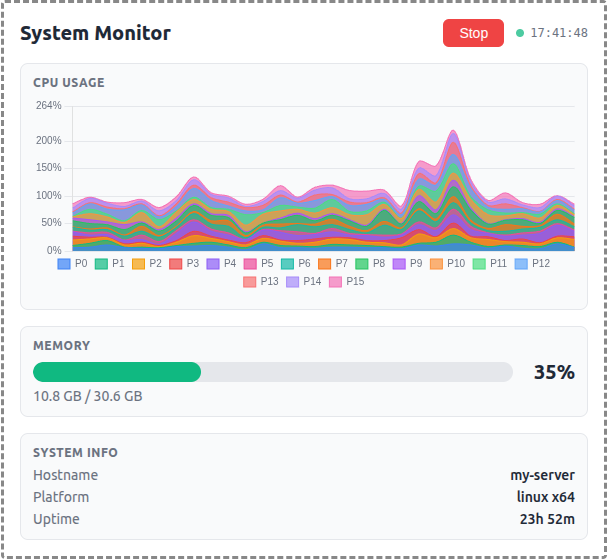
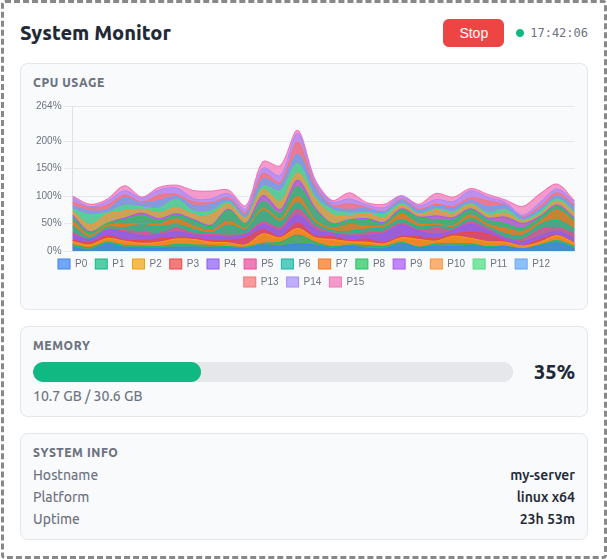
A demo MCP App that displays real-time OS metrics with a stacked area chart for per-core CPU usage and a bar gauge for memory.
 |
 |
 |
Features
- Per-Core CPU Monitoring: Stacked area chart showing individual CPU core utilization over a 1-minute sliding window
- Memory Usage: Horizontal bar gauge with color-coded thresholds (green/yellow/red)
- System Info: Hostname, platform, and uptime display
- Auto-Polling: Automatically starts monitoring on load with 2-second refresh interval
- Theme Support: Adapts to light/dark mode preferences
Running
-
Install dependencies:
npm install -
Build and start the server:
npm run start:http # for Streamable HTTP transport # OR npm run start:stdio # for stdio transport -
View using the
basic-hostexample or another MCP Apps-compatible host.
Architecture
Server (server.ts)
Exposes a single get-system-stats tool that returns:
- Raw per-core CPU timing data (idle/total counters)
- Memory usage (used/total/percentage)
- System info (hostname, platform, uptime)
The tool is linked to a UI resource via _meta[RESOURCE_URI_META_KEY].
App (src/mcp-app.ts)
- Uses Chart.js for the stacked area chart visualization
- Polls the server tool every 2 seconds
- Computes CPU usage percentages client-side from timing deltas
- Maintains a 30-point history (1 minute at 2s intervals)
- Updates all UI elements on each poll