 d05e76d470
- verify:skills:cli — the authoritative validator is now a GUARANTEED step in
  `local:gate` and CI, not a best-effort hand-off. It resolves the CLI itself
  (an installed one at 2.1.233+, else a pinned `npx -y`), so both tiers run the
  same script and cannot drift. `verify:skills` keeps skipping when the CLI is
  absent, which is right for `validate`: fast, offline, no Claude Code required.
- skill-manifest: the 1,536-char listing-entry cap covers `description` +
  `when_to_use` together; checking the description alone passed an over-cap
  entry. `when_to_use` is now parsed, validated and counted, with boundary tests
  at 1,536/1,537.
- verify-skills: report the budget as *this repo's contribution*. The real
  listing budget is shared with bundled skills and the contributor's own
  ~/.claude/skills, none of which is visible from here, so the number was
  claiming more than it measured.
- skill-eval: a negative case now means "no skill OF THIS REPO'S fired". It
  failed on any Skill invocation, so a contributor with an unrelated global
  skill got a false failure about their environment rather than these skills.
- docs/architecture + local-dev: the Node backend runner gets its
  `@inspector/core` alias from `clients/web/tsup.runner.config.ts`, not from
  Vite. The old text sent runner work to the wrong config.
- local-dev: the tarball does not ship "only each client's build/" — the
  allowlist also carries `clients/web/dist`, `clients/web/static` and the
  install helper. States the invariant that actually matters instead.
- issue-triage: the test for needing triage is "no board card". Adding "and no
  milestone" would skip the approved-but-unboarded case the same section then
  handles. Also corrected the `$M` note: the lookup is `--state all`, so closed
  issues DO have entries — `isopen` is about the invariants, not the lookup.
- issue-create: replaced "all five" with a per-version table. Steps 3 and 6
  (milestone, Priority) do not exist for v1, so the old list opened with a rule
  the same skill later tells you to violate.

Signed-off-by: cliffhall <cliff@futurescale.com>
2.6 KiB
Architecture
The @inspector/core shared package
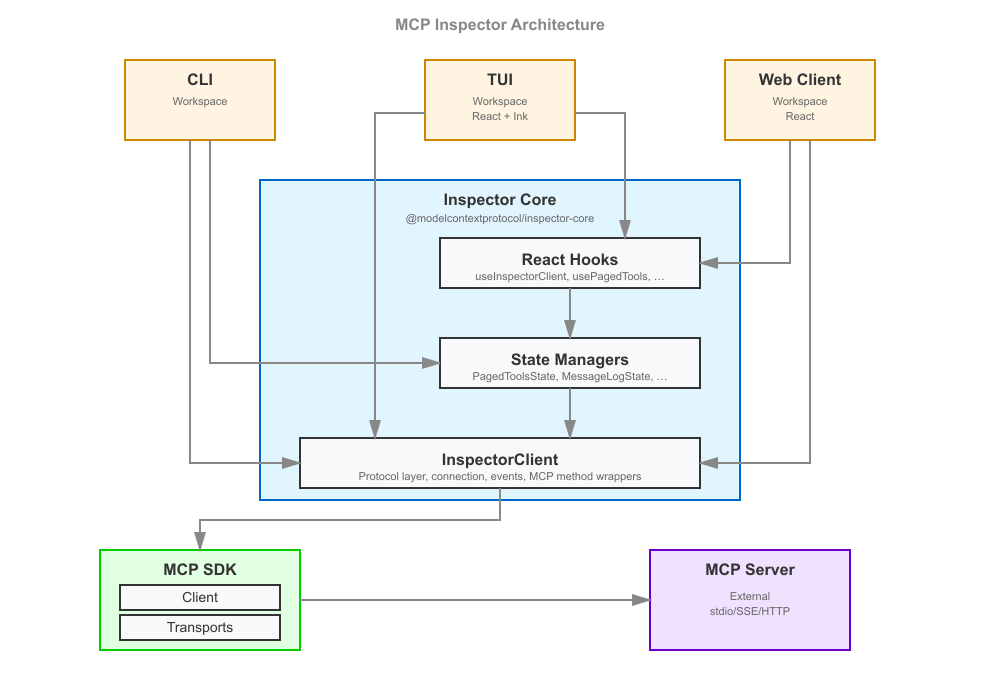
core/ holds the logic shared by all three clients so that web, CLI, and TUI behave identically. Its entry point is the InspectorClient class (core/mcp/), which owns the connection to an MCP server, the request/response lifecycle, and a set of state stores; core/react/ exposes React hooks over those stores that both the web and TUI (Ink) React trees consume. OAuth (core/auth/) is factored into isomorphic logic plus browser/node/remote backends so the same flows work in the browser, in Node, and against a remote backend.
core/ intentionally has no package.json — it is not published on its own. Each client bundles it in via a @inspector/core alias:
- CLI / TUI:
esbuildOptions.aliasin theirtsup.config.tsmaps@inspector/core→ the repocore/directory, andnoExternal: [/^@inspector\/core/]inlines it into the bundle. - Web: two configs, because the client is two builds —
clients/web/vite.config.tsfor the browser app, andclients/web/tsup.runner.config.tsfor the Node backend runner, which defines the alias itself.
Publishing core/ as its own package (e.g. for third parties to build on) is deliberately deferred — see issue #1636.
Web client: "dumb components" + Storybook
The v2 web client is built from presentational ("dumb") components — they accept data and callbacks as props and contain only display logic, with no direct data fetching or client state. State comes from the @inspector/core hooks, wired in near the top of the tree. This keeps components isolated, testable, and documentable.
That approach is what makes Storybook first-class here: every screen and element component has a *.stories.tsx file (96+ stories) that renders it against fixture props. Storybook play functions double as interaction tests, run headless in GitHub CI (test:storybook, Chromium via Playwright) and in the local gate (npm run local:storybook, which installs the browser first).
Styling follows a strict Mantine-first convention (theme variants and component props over CSS classes, --inspector-* CSS custom properties over raw color literals). The full rules live in AGENTS.md under React instructions — read them before touching web UI. Element components live in clients/web/src/components/elements/; theme variants in clients/web/src/theme/.