 d552564966
* Network: modern Mcp-* headers, new error codes, cancellation-as-abort (#1628)

Upgrade the Network tab for the modern Streamable HTTP transport
(SEP-2243 / SEP-2575):

- Recognise and highlight the mirrored headers (Mcp-Method, Mcp-Name,
  Mcp-Param-*, MCP-Protocol-Version), decode =?base64?…?= sentinel values
  inline, and cross-check each against the request body so a HeaderMismatch
  is visible before the server rejects it.
- Show the new spec error codes distinctly: -32020 HeaderMismatch,
  -32021 MissingRequiredClientCapability, -32022 UnsupportedProtocolVersion
  (with the server-advertised `supported` versions), and modern -32601
  MethodNotFound on HTTP 404 (distinguished from a legacy bare 404 by its
  JSON-RPC body).
- Reflect cancellation as a connection abort ("Cancelled") rather than a
  hard error, per SEP §7.5.
- Confirm and document browser-path header mirroring: the SDK builds the
  Mcp-* headers client-side and the /api/fetch proxy forwards them verbatim
  (new integration test).

New pure util `mcpNetworkHeaders.ts` holds the recognition/decode/classify
logic; new `McpErrorBadge` element renders the distinct error chips. The
optional raw-request controls (cacheMode bypass/refresh, single-page fetch)
are split to #1721 — they are cross-cutting core + feature-tab work beyond
the Network tab.

Also refreshes the AGENTS.md board Status option-ID table (the Building /
MCP Apps Extension columns were removed).

Closes #1628

Co-Authored-By: Claude Opus 4.8 (1M context) <noreply@anthropic.com>
Claude-Session: https://claude.ai/code/session_01XNdjEPKLG637X8YmhDiEk5

* Network smoke-test showcase + fix redaction clobbering JSON-RPC error codes

Adds a composable "modern-network" showcase server for exercising the #1628
Network-tab work end-to-end, and fixes a real bug the smoke test surfaced.

Bug fix (core): the fetch-tracking body redaction masked ANY field named
`code` (targeting the OAuth authorization code), including the numeric
JSON-RPC `error.code`. That destroyed the field the Network tab classifies
the modern spec errors on, so -32020/-32021/-32022/-32601 never rendered
against real traffic. Redaction now only masks STRING values of a sensitive
field (secrets are always strings; a numeric code is never one).

Test-server showcase (test-servers): `modern-network-http.json` serves a
`get_weather` tool with an `x-mcp-header: "City"` annotation plus four
`trigger_*` tools. A new `transport.modern.injectSpecErrors` flag installs a
middleware on the modern leg that answers the triggers with real HTTP status
+ JSON-RPC error bodies (400/-32020, 400/-32021, 400/-32022 w/ `supported`,
404/-32601), so the Inspector's error rendering can be driven live.

Mirroring finding (verified live, comment corrected in createRemoteFetch.ts):
the SDK builds the STANDARD mirrored headers (Mcp-Method / Mcp-Name /
MCP-Protocol-Version) unconditionally — they reach the server through the
web proxy — but gates `Mcp-Param-*` on a non-browser environment
(`detectProbeEnvironment() !== "browser"`), so the web client never emits
them. An x-mcp-header tool is therefore uncallable from the web client
against a strict modern server (it answers -32020); it works from the Node
CLI/TUI. The earlier "mirroring works through the proxy" note was corrected.

Co-Authored-By: Claude Opus 4.8 (1M context) <noreply@anthropic.com>
Claude-Session: https://claude.ai/code/session_01XNdjEPKLG637X8YmhDiEk5

* Network: move the spec-error badge off the crowded compact top row

In the narrow monitoring sidebar (embedded layout) the McpErrorBadge shared
the top row with the timestamp/method/category/duration/status chips, which
truncated the method and category ("PO…", "TRANSP…") and clipped the error
name. Render the badge separately from `metaBadges` and place it on the
second row, to the right of the URL, so the top row stays readable and the
error name shows in full. The full-width layout keeps it in the top-right
cluster (where there's room).

Co-Authored-By: Claude Opus 4.8 (1M context) <noreply@anthropic.com>
Claude-Session: https://claude.ai/code/session_01XNdjEPKLG637X8YmhDiEk5

* Network: keep the spec error name's casing in McpErrorBadge (no uppercase)

The four spec/SDK error identifiers are PascalCase (`HeaderMismatch`,
`MissingRequiredClientCapability`, `UnsupportedProtocolVersion`,
`MethodNotFound`). Mantine's Badge uppercases label text by default, which
flattened them to a hard-to-read run-together string
("UNSUPPORTEDPROTOCOLVERSION"). Set `tt="none"` so the badge shows the
spec's own casing with word boundaries intact; short badges (POST, status)
keep the default uppercase.

Co-Authored-By: Claude Opus 4.8 (1M context) <noreply@anthropic.com>
Claude-Session: https://claude.ai/code/session_01XNdjEPKLG637X8YmhDiEk5

* Network: in the full-width layout, move the spec-error badge to the second row

The full-width entry kept the McpErrorBadge in the top-right cluster, where a
long spec name (e.g. "MissingRequiredClientCapability") crowded the top row
and truncated the method chips and URL. Move it to the start of the second
row (the expand-toggle row) so the top row stays readable; the toggle stays
at the end (`space-between` only when the badge is present). The compact
sidebar already places it on its second row beside the URL.

Co-Authored-By: Claude Opus 4.8 (1M context) <noreply@anthropic.com>
Claude-Session: https://claude.ai/code/session_01XNdjEPKLG637X8YmhDiEk5

* Protocol: show Replay as the right-side icon in the wide layout too

The compact (sidebar) ProtocolEntry already renders Replay as an icon next to
the pin/expand icons; the wide layout used a left-aligned "Replay" text
button instead. Make the wide layout match — Replay as the ReplayButton icon
at the start of the right-side action cluster (Replay, Pin, Expand) — so the
two layouts are consistent. Drops the now-unused SubtleButton constant.

Co-Authored-By: Claude Opus 4.8 (1M context) <noreply@anthropic.com>
Claude-Session: https://claude.ai/code/session_01XNdjEPKLG637X8YmhDiEk5

* Move the modern spec-error chip + alert from the Network tab to the Protocol tab

The Network tab is focused on the HTTP transaction; the distinct protocol-error
taxonomy (-32020/-32021/-32022/-32601) belongs with the protocol messages. So:

- ProtocolEntry now renders the McpErrorBadge chip on the top line (right after
  the direction badge, both layouts) plus an explanatory alert in the expanded
  detail, classified by JSON-RPC error code via `classifyProtocolSpecError`.
- NetworkEntry drops the chip + alert; it keeps the HTTP-level features (status
  badge, Mcp-* header highlight/sentinel-decode, header/body mismatch marker,
  cancellation-as-abort).
- The SDK delivers -32020/21/22 (HTTP 400) as JSON-RPC error responses, so they
  reach the Protocol log directly. -32601 (HTTP 404) and other non-enveloped
  errors are *thrown* — the request stays pending. `enrichProtocolEntries`
  (App) correlates the Protocol log to the Network log by JSON-RPC id (parsed
  from the transport fetch's requestBody) and folds the thrown error onto its
  pending request, so it too appears in Protocol. This is a derived view; the
  underlying log is not mutated.

Verified live against the modern-network showcase: both a -32020 error response
and a thrown -32601 render distinctly in the Protocol tab.

Follow-up: a "reveal in Network" link on the Protocol alert (cross-tab
scroll-to + expand of the correlated HTTP entry).

Co-Authored-By: Claude Opus 4.8 (1M context) <noreply@anthropic.com>
Claude-Session: https://claude.ai/code/session_01XNdjEPKLG637X8YmhDiEk5

* Protocol: show the spec-error chip only in the wide layout, after the method

Refine the placement of the spec-error chip added in the previous commit:
- Wide layout: move it from after the direction badge to right after the
  method chip (reads as "tools/call  -32020 HeaderMismatch").
- Compact sidebar row: drop the chip entirely — the two-line row stays
  uncluttered and relies on its ERROR status badge. The explanatory alert
  still appears in the expanded detail in both layouts.

Co-Authored-By: Claude Opus 4.8 (1M context) <noreply@anthropic.com>
Claude-Session: https://claude.ai/code/session_01XNdjEPKLG637X8YmhDiEk5

* Protocol: "reveal in Network" link — jump from a spec error to its HTTP entry

Adds the cross-tab navigation that was the follow-up to relocating the
spec-error rendering. The expanded Protocol alert now shows a "View the HTTP
request in the Network tab" link when the entry has a correlated Network
request; clicking it:

- correlates the Protocol message to its transport fetch by JSON-RPC id
  (`revealableMessageIds` gates the link; `correlateFetchEntry` finds the
  target on click),
- clears whatever filter would hide the target (network filterText +
  category, and the embedded monitorSearch),
- switches to the Network view in whichever mode is active — the pinned
  column (`pinMonitor`) when the sidebar is open, or the full-screen header
  tab (`onActiveTabChange`) when it's closed,
- scrolls the matching NetworkEntry into view and force-expands it.

The reveal is a one-shot: a new `revealId` threads NetworkScreen →
NetworkStreamPanel → NetworkEntry, where the targeted entry scrolls itself
into view (rAF, after `useScrollMemory`'s restore) + expands, then clears the
signal via `onRevealComplete`. Verified live in both the pinned-sidebar and
closed/full-screen layouts.

Co-Authored-By: Claude Opus 4.8 (1M context) <noreply@anthropic.com>
Claude-Session: https://claude.ai/code/session_01XNdjEPKLG637X8YmhDiEk5

* Protocol: only show the "reveal in Network" link when it adds value

Gate the link on a new `httpRelevant` flag: show it only when the error is
either thrown by the SDK (its real HTTP response lives only in the Network
log — the Protocol entry is a synthetic fold) OR tied to the HTTP request
headers. A delivered, protocol-only error gets no link, since the raw HTTP
entry adds nothing over the alert.

- -32020 HeaderMismatch  → link (the mirrored headers are the problem)
- -32601 MethodNotFound  → link (thrown; the 404 response is only in Network)
- -32021 MissingRequiredClientCapability → no link (delivered, protocol-only)
- -32022 UnsupportedProtocolVersion      → no link (supported list is in the alert)

Co-Authored-By: Claude Opus 4.8 (1M context) <noreply@anthropic.com>
Claude-Session: https://claude.ai/code/session_01XNdjEPKLG637X8YmhDiEk5

* Network: cite SEP-2575 for cancellation-as-abort, not the internal doc's §7.5

The cancellation note referenced "(SEP §7.5)", but §7.5 is a section of the
internal v2_new_spec_impact.md doc, not a SEP. The behavior — closing the
Streamable HTTP request stream is the cancellation signal; notifications/cancelled
is stdio-only — is defined in SEP-2575 (stateless-mcp). Cite SEP-2575 in the
user-facing alert and the two related comments.

Co-Authored-By: Claude Opus 4.8 (1M context) <noreply@anthropic.com>
Claude-Session: https://claude.ai/code/session_01XNdjEPKLG637X8YmhDiEk5

* Network: fix reveal one-shot canceling its own scroll; review doc/comment nits

Address @claude review of #1722:
- Reveal one-shot: move onRevealComplete() inside the rAF (after scrollIntoView)
  so clearing revealId (which flips revealed->false and runs the effect cleanup)
  can no longer race/cancel the pending scroll. Add a flip-back test.
- Comment the intentional double-mount of revealId (pinned monitor + full-screen
  ScreenStage both match; clear is idempotent).
- Doc drift after the Network->Protocol relocation: McpErrorBadge + the
  mcpNetworkHeaders module header now say the spec-error chip lives in Protocol.

Co-Authored-By: Claude Opus 4.8 (1M context) <noreply@anthropic.com>
Claude-Session: https://claude.ai/code/session_01XNdjEPKLG637X8YmhDiEk5

* Network: clarify redaction array-of-scalars edge + revealableIds superset

Address second @claude review of #1722 (both non-blocking polish notes):
- fetchTracking redaction: note that masking assumes a sensitive value is a
  scalar or object; an array-of-scalars under a sensitive key would slip through
  (no OAuth/token payload has that shape).
- revealableMessageIds: document it's a superset of the linked entries; the
  spec-error/httpRelevant narrowing is applied downstream at render.

Co-Authored-By: Claude Opus 4.8 (1M context) <noreply@anthropic.com>
Claude-Session: https://claude.ai/code/session_01XNdjEPKLG637X8YmhDiEk5

* Protocol: gate modern -32601 framing to a genuine 404, not in-band 200

Address third @claude review of #1722. classifyProtocolSpecError recognised
-32601 from the code alone, so an ordinary in-band 'method not found' returned
on HTTP 200 was dressed up as the modern MethodNotFound taxonomy: the spec
badge, a 404-asserting alert, and a 'reveal in Network' link that jumped to a
plain 200 (claiming diagnostic value that wasn't there).

Gate the modern -32601 treatment on the correlated fetch actually being a 404
(mirroring classifyMcpSpecError). -32020/-32021/-32022 are SEP-reserved and
unaffected. The correlated HTTP status is threaded from InspectorView (new
correlatedFetchStatusById) through ProtocolScreen/ProtocolListPanel to
ProtocolEntry; when unknown, -32601 falls back to code-only recognition (the
thrown-404 path always carries a 404). Badge, alert copy, and link now resolve
together, so a plain in-band -32601 falls through to ordinary error rendering.

Co-Authored-By: Claude Opus 4.8 (1M context) <noreply@anthropic.com>
Claude-Session: https://claude.ai/code/session_01XNdjEPKLG637X8YmhDiEk5

* Protocol: require a genuine 404 for modern -32601 (drop unknown-status fallback)

Address fourth @claude review of #1722. The prior fix only rejected -32601 when
the status was *known* and not 404; an unknown status fell back to code-only
recognition. But the thrown-404 path always carries a 404 (folded in from a 404
fetch), so the unknown-status branch is only ever reached by an ordinary in-band
-32601 with no correlated 404 — most notably a stdio connection (no HTTP at all)
— which then wrongly got the modern MethodNotFound badge and 404-asserting copy.

Drop the escape hatch: -32601 is the modern taxonomy only on httpStatus === 404.
Nothing intended is lost (the genuine case always has its 404). Update the tests
(code-only/undefined -32601 now expects null; add a stdio no-correlated-fetch
ProtocolEntry case) and mark the MethodNotFound story with correlatedHttpStatus
404.

Co-Authored-By: Claude Opus 4.8 (1M context) <noreply@anthropic.com>
Claude-Session: https://claude.ai/code/session_01XNdjEPKLG637X8YmhDiEk5

---------

Co-authored-by: Claude Opus 4.8 (1M context) <noreply@anthropic.com>
20 KiB
MCP Inspector
A developer tool for inspecting Model Context Protocol (MCP) servers. It ships as a single package, @modelcontextprotocol/inspector, that provides three ways to inspect a server:
- Web — a Vite + React + Mantine single-page app with a Node backend.
- CLI — a scriptable command-line client for automation, CI, and fast agent feedback loops.
- TUI — an interactive terminal UI built with Ink.
All three run through one global mcp-inspector binary:
npx @modelcontextprotocol/inspector          # web UI (default)
npx @modelcontextprotocol/inspector --cli    # CLI
npx @modelcontextprotocol/inspector --tui    # TUI
Repo status. This is the v2 line of the Inspector (branch
v2/main). Themainbranch is the legacy v1 implementation (bug fixes only). v2 will eventually replacemain. SeeAGENTS.mdfor branch/board conventions.
Project layout
v2 is not an npm workspace. Each client under clients/* keeps its own package.json and node_modules; shared code lives in core/ and is consumed via a @inspector/core build-time alias (no package.json of its own). A single npm install at the root cascades installs into every client (see Setup).
inspector/
├── clients/
│   ├── web/          # Web client (Vite + React + Mantine). src/ = browser app; server/ = Node dev/prod backend
│   ├── cli/          # CLI client (tsup bundle, @inspector/core alias)
│   ├── tui/          # TUI client (Ink + React, tsup bundle)
│   └── launcher/     # Shared launcher — provides the `mcp-inspector` bin, dispatches to web/cli/tui
├── core/             # Shared code consumed via the `@inspector/core` alias (no package.json)
│   ├── auth/         # OAuth: providers, discovery, storage, mid-session recovery (browser/node/remote backends)
│   ├── json/         # JSON + parameter/argument conversion utilities
│   ├── logging/      # Silent pino logger singleton
│   ├── mcp/          # InspectorClient runtime, state stores, transports, config import
│   ├── react/        # React hooks over the state stores
│   └── storage/      # File I/O helpers for the OAuth persist backends
├── test-servers/     # Composable MCP test servers + fixtures used by integration tests
├── scripts/          # Root build/verify tooling (install cascade, smokes, pack:verify)
├── specification/    # Design/build specifications
├── AGENTS.md         # Contribution rules for agents AND humans (see below)
└── README.md         # You are here
Each client has its own README with client-specific detail: web · cli · tui · launcher.
Task-oriented guides live under docs/ — see Reviewing an MCP App, the CLI-first → one-shot-web recipe for automated App-tool review: --app-info probe → deep-link navigate → rendered widget, plus OAuth handoff and proxy support.
Setup
Requires Node >=22.19.0.
npm install # root install; postinstall cascades into every client
- Fresh clone: run
npm installat the repo root. - After a pull that changes a client's dependencies: re-run
npm installat the root to re-sync every client.
The cascade (scripts/install-clients.mjs) is dev-only — it exits early when the package is installed as a dependency, and the published tarball ships only each client's build/, so end users are unaffected. Set INSPECTOR_SKIP_CLIENT_INSTALL=1 to skip it.
Running during development
For day-to-day web iteration, run Vite directly from the web client (fast HMR, no launcher build needed):
cd clients/web && npm run dev
The launcher-driven scripts below run the built launcher, so build first (npm run build):
npm run web        # prod web launcher against clients/web/dist
npm run web:dev    # web launcher in --dev mode (Vite)
The @inspector/core shared package
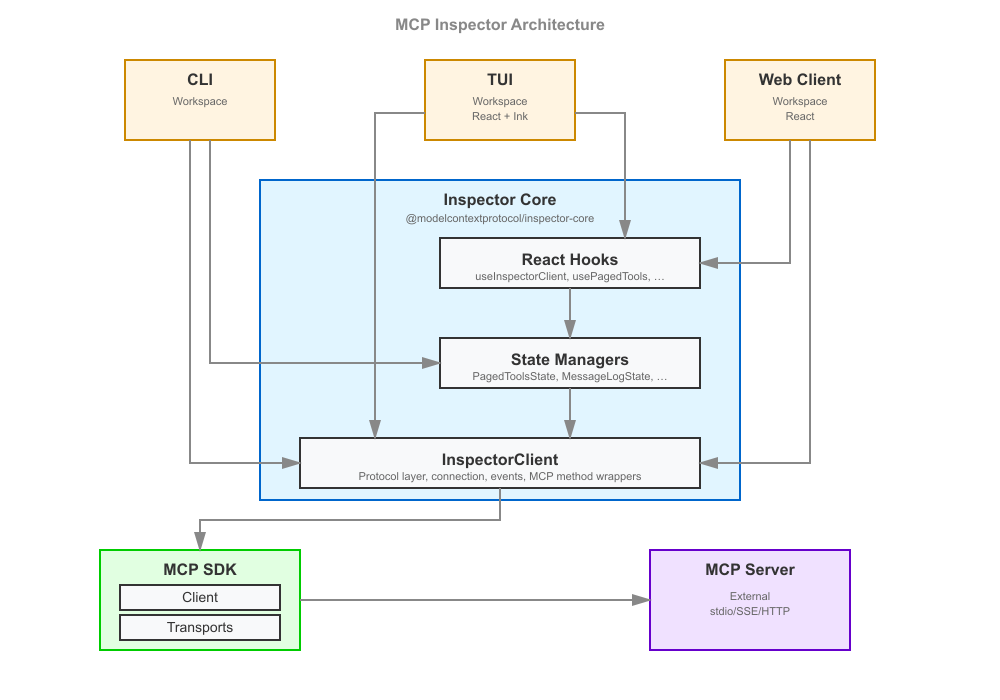
core/ holds the logic shared by all three clients so that web, CLI, and TUI behave identically. Its entry point is the InspectorClient class (core/mcp/), which owns the connection to an MCP server, the request/response lifecycle, and a set of state stores; core/react/ exposes React hooks over those stores that both the web and TUI (Ink) React trees consume. OAuth (core/auth/) is factored into isomorphic logic plus browser/node/remote backends so the same flows work in the browser, in Node, and against a remote backend.
core/ intentionally has no package.json — it is not published on its own. Each client bundles it in via a @inspector/core alias:
- CLI / TUI:
esbuildOptions.aliasin theirtsup.config.tsmaps@inspector/core→ the repocore/directory, andnoExternal: [/^@inspector\/core/]inlines it into the bundle. - Web: the same alias in
clients/web/vite.config.tsfor the browser app and the Node backend runner.
Publishing core/ as its own package (e.g. for third parties to build on) is deliberately deferred — see issue #1636.
Web client: "dumb components" + Storybook
The v2 web client is built from presentational ("dumb") components — they accept data and callbacks as props and contain only display logic, with no direct data fetching or client state. State comes from the @inspector/core hooks, wired in near the top of the tree. This keeps components isolated, testable, and documentable.
That approach is what makes Storybook first-class here: every screen and element component has a *.stories.tsx file (96+ stories) that renders it against fixture props. Storybook play functions double as interaction tests, run headless in CI (npm run ci:storybook, Chromium via Playwright).
Styling follows a strict Mantine-first convention (theme variants and component props over CSS classes, --inspector-* CSS custom properties over raw color literals). The full rules live in AGENTS.md under React instructions — read them before touching web UI. Element components live in clients/web/src/components/elements/; theme variants in clients/web/src/theme/.
Test servers
test-servers/ provides composable MCP servers used by the integration and smoke suites, so tests exercise a real server over a real transport instead of mocks. A server is assembled from presets (fixture factories in test-servers/src/preset-registry.ts — tools, resources, prompts, tasks, elicitation, sampling, OAuth, …) and can be driven two ways:
- In-process — import the factories (
createTestServerHttp,createEchoTool, …) and run the server inside the test's event loop (used by the HTTP integration paths). - As a subprocess —
test-servers/build/test-server-stdio.jsis spawned as a real stdio child (used by the CLI smoke and stdio integration tests).
Configure a server declaratively with a JSON config (see test-servers/configs/*.json) selecting presets, then load it via --config. Because the servers are spawned as real subprocesses, the build output must exist first:
npm run test-servers:build # (from clients/web) → tsc -p test-servers, emits test-servers/build/
The Vite alias @modelcontextprotocol/inspector-test-server (in clients/web/vite.config.ts) points at test-servers/build/index.js so getTestMcpServerPath() resolves to a real .js path.
A streamable-HTTP server can also serve the modern (2026-07-28) protocol era via the SDK's createMcpHandler — set transport.modern in the JSON config (true for dual-era stateless serving, or { "legacy": "reject" } for modern-only strict), or pass modern on the ServerConfig for an in-process createTestServerHttp. This is what lets an Inspector connection negotiating protocolEra: "auto" | "modern" reach the modern leg (populated server/discover, sessionless). See test-servers/configs/modern-http.json. test-servers/configs/modern-mrtr-http.json additionally serves the mrtr_confirm tool (preset mrtr_confirm, createMrtrTool) over the modern leg: its handler returns inputRequired(...) embedding a form elicitation, so invoking it produces a real MRTR round-trip (input_required → the client fulfils the embedded elicitation and retries with a new id → complete). The Inspector drives MRTR manually (inputRequired: { autoFulfill: false }), so the embedded elicitation pauses at the pending-request modal (tagged "input_required") for you to answer, then the retry completes — useful for eyeballing both that pending-request UX and the Protocol view's MRTR conversation grouping. test-servers/configs/mrtr-showcase-http.json bundles every MRTR preset in one modern server for manual testing: mrtr_confirm (single round), mrtr_two_step (two elicitation rounds via requestState), mrtr_sample (embedded sampling → the Sampling panel), mrtr_roots (embedded roots/list, auto-answered silently from configured roots — no modal), mrtr_edge (an inputRequests-only round then a requestState-only round), and mrtr_loop (never completes → the MRTR_MAX_ROUNDS bound trips). (The legacy collect_elicitation preset calls server.elicitInput, which errors on the 2026-07-28 leg — server→client requests aren't allowed there; MRTR is the modern replacement.)
test-servers/configs/modern-network-http.json is the Network-tab showcase for the standardized HTTP headers and new error taxonomy (SEP-2243 / SEP-2575). It serves a get_weather tool whose city argument carries an x-mcp-header: "City" annotation (so a modern client mirrors it to Mcp-Param-City), plus four trigger_* tools that the modern leg's spec-error injector (transport.modern.injectSpecErrors: true) answers with a real HTTP status + JSON-RPC error body: trigger_header_mismatch → 400 / -32020, trigger_missing_capability → 400 / -32021, trigger_unsupported_version → 400 / -32022 (with data.supported), trigger_method_not_found → 404 / -32601. Connect to it with Protocol Era = Modern and open the Network tab to see the mirrored Mcp-* headers highlighted, sentinel values decoded, and each error rendered distinctly. Note: Mcp-Param-* mirroring is skipped by the SDK in the browser (detectProbeEnvironment() !== "browser"), so calling get_weather from the web client omits Mcp-Param-City and the strict server answers -32020 — the same tool is callable from the Node CLI/TUI, where mirroring is active.
Building
npm run build # builds all clients: web → cli → tui → launcher
Individual clients: build:web, build:cli, build:tui, build:launcher. The web build produces both the browser SPA (clients/web/dist, Vite) and the Node prod-server runner (clients/web/build, tsup).
Testing & the quality gate
Each client self-validates from its own folder; the root scripts chain them. There is no aggregate root test script — use validate (fast) or coverage (the gate).
| Script | What it does |
|---|---|
npm run validate |
format:check + lint + build + fast unit tests, per client. The quick inner-loop check. |
npm run coverage |
The per-file ≥90% gate (lines/statements/functions/branches) under v8 instrumentation, per client. CI-enforced. For web this also runs the integration project. |
npm run smoke |
End-to-end smokes through the built launcher (--help dispatch + prod cli/tui/web). |
npm run ci |
Mandatory pre-push command. validate → coverage → smoke → Storybook. A true superset of GitHub CI. |
npm run pack:verify |
Publish smoke — see Publishing. |
Per-client scripts exist too (validate:web, coverage:cli, smoke:tui, …). Run npm run format (per client) before committing — validate runs the non-fixing format:check and fails CI on any unformatted file.
For the full testing rules — the ≥90% per-file gate, where test files live, the unit vs. integration vs. storybook projects, and the v8 ignore policy — see AGENTS.md.
Publishing
The root @modelcontextprotocol/inspector package ships as one tarball with a single version number — no separate -web / -cli / -tui / -core packages. npm run build builds every client, then prepack runs before npm publish. Runtime dependencies are declared on the root package.json; client builds bundle @inspector/core and externalize npm packages resolved from the root install.
What ships, and the packaging invariants
The root package.json "files" allowlist is the source of truth for the tarball. A few non-obvious entries exist because they are read at runtime or were silently dropped by npm's packlist — do not remove them without re-running npm run pack:verify:
- No source maps. The client bundlers set
sourcemap: false(clients/{cli,tui}/tsup.config.ts,clients/web/tsup.runner.config.ts); Vite and the launcher'stscalready emit none. Maps are ~half the unpacked size and aren't needed at runtime — debug vianpm run devon the source. clients/web/buildships viaclients/web/.npmignore.clients/web/.gitignorelistsbuild/, and npm's packlist honors that nested.gitignoreover the root"files"allowlist — so the prod web-server runner was silently missing from the tarball whileclients/web/distslipped through (its.gitignoreonly listsdist-ssr).clients/web/.npmignoreoverrides the.gitignorefor publishing so bothbuild/(runner) anddist/(SPA) ship. The other clients don't need this — none ship a nested.gitignore.- A single version number, read from the root
package.json. The Inspector ships as one package with one version, so only the rootpackage.jsoncarries aversion— the fourclients/*/package.jsons deliberately have none. Every Node client (CLI, TUI, and the web backend) resolves the version through the sharedreadInspectorVersion()reader incore/node/version.ts, which walks up to the root manifest (always present in the tarball). No clientpackage.jsonis read at runtime, so none needs to ship. The web browser can't read the filesystem; it gets its version from the backend viaGET /api/config(see #1639).
npm run pack:verify — publish smoke against the real tarball
The smoke:* scripts run against the in-repo build tree, which is not the published package. npm run pack:verify (scripts/pack-and-verify.mjs) closes that gap: it builds, npm packs the publishable tarball (asserting no source maps ship and that the runtime-required files are present), installs the tarball into a clean throwaway consumer — a fresh temp directory where it runs a real npm install <tgz> (pulls runtime deps, runs postinstall), exactly as npx @modelcontextprotocol/inspector would — and drives the installed mcp-inspector bin end to end: --help dispatch, a real --cli tools/list over stdio, and a prod --web boot that must serve / from the shipped dist. It catches "works in --dev, breaks under npx …" path/packaging failures. It requires network access (the install pulls deps), so it is a local / release check, not part of the fast validate/ci loop.
Cutting a release
Publishing is automated by two release-gated jobs in .github/workflows/main.yml (github.event_name == 'release', both needs: build):
publish— the npm package. Runsnpm run pack:verifyas the pre-publish gate, asserts the release tag matches the rootpackage.jsonversion, thennpm publish --access public --provenance— a singlenpm publish(v2 is not an npm workspace, so there is no v1-stylepublish-all/--workspaces), with a signed provenance attestation via GitHub OIDC (id-token: write,environment: release,NPM_TOKEN).publish-github-container-registry— the container image (see Docker).
Because there is one version number (only the root package.json has one — the clients carry none, so there is nothing to keep in sync and no check-version step), the release flow is just:
npm version <major|minor|patch>   # bumps the root package.json + tags
git push --follow-tags
# then draft & publish a GitHub Release for that tag → triggers `publish`
The release's target commit selects which workflow runs, so this only publishes when a release is cut from a commit carrying this (v2) workflow.
Docker
A container image is published to GHCR (ghcr.io/modelcontextprotocol/inspector, linux/amd64 + linux/arm64) by the release workflow. The Dockerfile is a two-stage build: the first stage installs and npm packs the publishable tarball; the second stage npm install -gs that tarball, so the image ships the exact same artifact as npm, with a clean mcp-inspector bin.
# run the web UI (reads the auth token from the container logs)
docker run --rm -p 6274:6274 ghcr.io/modelcontextprotocol/inspector

# or build the image locally
docker build -t mcp-inspector .
docker run --rm -p 6274:6274 mcp-inspector
The image defaults to --web bound to 0.0.0.0:6274 with browser auto-open disabled; override the args to run another mode (docker run --rm ghcr.io/modelcontextprotocol/inspector --cli …). Pass -e MCP_INSPECTOR_API_TOKEN=… to set a known token (otherwise one is generated and printed in the logs), or -e DANGEROUSLY_OMIT_AUTH=true to disable auth. The image runs as the non-root node user and has a HEALTHCHECK that probes the web UI — it assumes the default --web mode, so add --no-healthcheck when running --cli/--tui (which have no web server).
Contributing — AGENTS.md and CLAUDE.md
AGENTS.md is the contract for changing this codebase, and it applies to humans and AI agents alike. It is not agent-only boilerplate — it holds the project's real conventions: the issue-and-board workflow, branch/label rules, the TypeScript and Mantine/React standards, the testing and coverage requirements, and the mandatory pre-push gate. Read it before making changes, and keep it up to date when you change structure, tooling, or rules.
CLAUDE.md is the entry point the Claude Code agent loads automatically; it simply includes AGENTS.md and this README, so both agents and humans work from the same source of truth. If you use a different agent that reads AGENTS.md, you get the same rules.
A key rule worth surfacing here: all work is issue-driven. Before starting, find or create a tracking issue on the v2 project board; open PRs against v2/main with Closes #<issue>. The exact recipes (labels, board IDs, statuses) are in AGENTS.md.
License
MIT.