 43d41a242e
This PR reorganizes and extends the existing documentation in
preparation for publishing on https://modelcontextprotocol.io/.

The current plan is for docs to remain in this repo, and be synced to
the `modelcontextprotocol/modelcontextprotocol` whenever necessary
(e.g., accompanying a release of the registry). I have included a script
in
https://github.com/modelcontextprotocol/modelcontextprotocol/pull/1725
(`bin/pull-registry-docs.sh`) that can be run manually to perform the
sync.

If we later decide to permanently move the docs to the
`modelcontextprotocol/modelcontextprotocol` repo, that also works.

This PR puts all https://modelcontextprotocol.io/ docs into
`docs/modelcontextprotocol-io/`. Docs outside that subdirectory, such as
`docs/administration/admin-operations.md`, are intended to be accessible
solely via this repo. One major exception is the
`docs/reference/server-json/` subdirectory, which will depend on the
resolution of
https://github.com/modelcontextprotocol/modelcontextprotocol/issues/1649.
However, I think we could address that in a follow-up PR.

---------

Co-authored-by: Adam Jones <adamj+git@anthropic.com>
Co-authored-by: Claude <noreply@anthropic.com>
2.9 KiB
Ecosystem Vision
How the MCP Registry fits into the broader ecosystem and our vision for the future.
The Registry Ecosystem
The MCP registry provides MCP clients with a list of MCP servers, like an app store for MCP servers. (In the future it might do more, like also hosting a list of clients).
There are two parts to the registry project:
- 🟦 The MCP registry spec: An API specification that allows anyone to implement a registry.
- 🟥 The Official MCP registry: A hosted registry following the MCP registry spec at
registry.modelcontextprotocol.io. This serves as the authoritative repository for publicly-available MCP servers. Server creators publish once, and all consumers (MCP clients, aggregators, marketplaces) reference the same canonical data. This is owned by the MCP open-source community, backed by major trusted contributors to the MCP ecosystem such as Anthropic, GitHub, PulseMCP and Microsoft.
The registry is built around the server.json format - a standardized way to describe MCP servers that works across discovery, initialization, and packaging scenarios.
In time, we expect the ecosystem to look a bit like this:
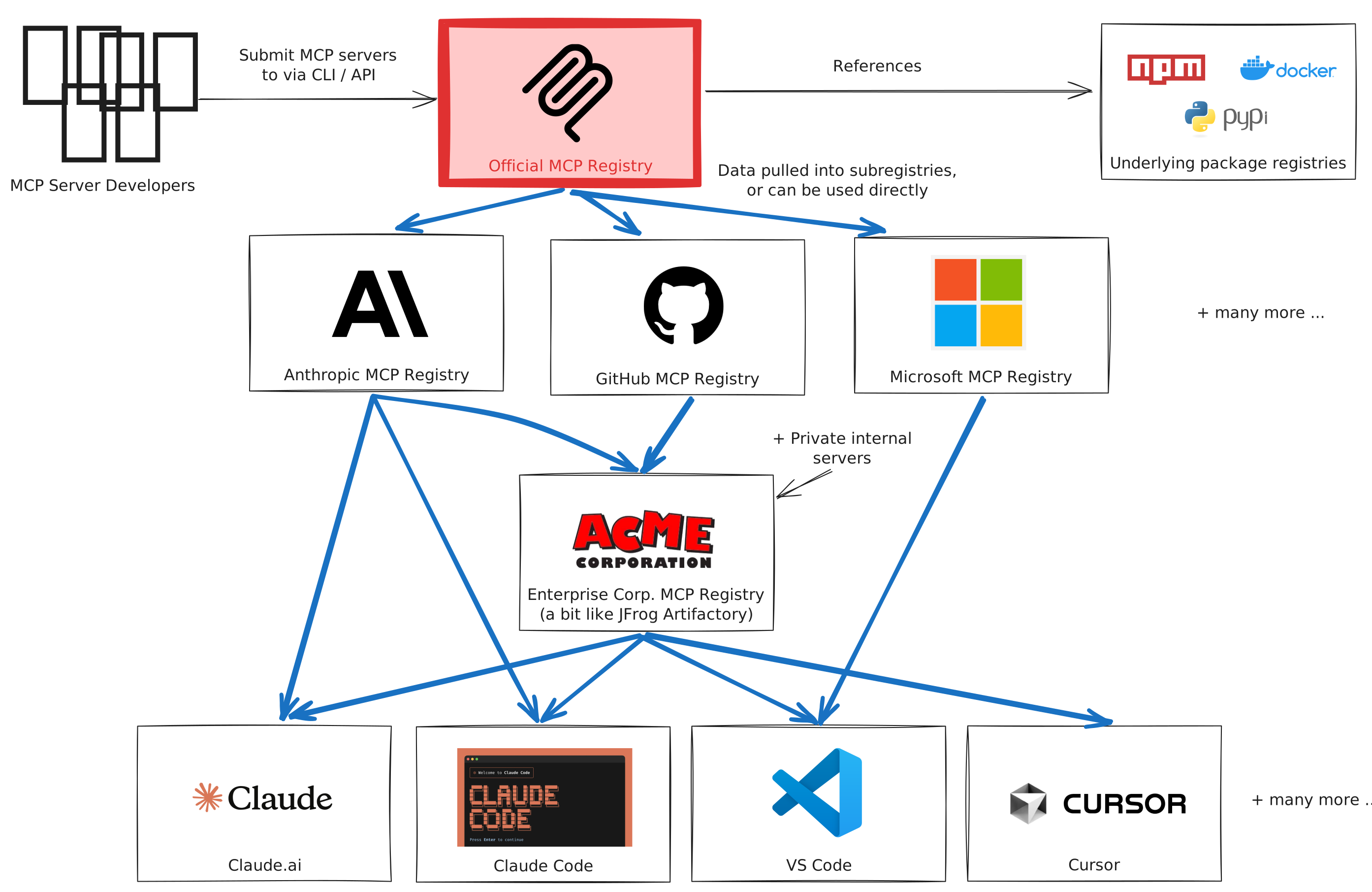
Note that MCP registries are metaregistries. They host metadata about packages, but not the package code or binaries. Instead, they reference other package registries (like NPM, PyPi or Docker) for this.
Additionally, we expect clients pull from subregistries. These subregistries add value to the registry ecosystem by providing curation, or extending it with additional metadata. The Official MCP registry expects a lot of API requests from ETL jobs from these subregistries.
Registry vs Package Registry
Key distinction: MCP Registries are metaregistries.
- Package registries (npm, PyPI, Docker Hub) host actual code/binaries
- The MCP Registry hosts metadata pointing to those packages
MCP Registry: "weather-server v1.2.0 is at npm:weather-mcp"
NPM Registry: [actual weather-mcp package code]
Official vs Community Registries
Official MCP Registry (registry.modelcontextprotocol.io):
- Canonical source for publicly-available servers
- Community-owned, backed by trusted contributors
- Focuses on discoverability and basic metadata
Subregistries (Smithery, PulseMCP, etc.):
- Add value through curation, ratings, enhanced metadata
- ETL from official registry + additional annotations
- Serve specific communities or use cases
How Servers Are Represented
Each server entry contains:
- Identity: Unique name (
io.github.user/server-name) - Packages: Where to download it (
npm,pypi,docker, etc.) - Runtime: How to execute it (args, env vars)
- Metadata: Description, capabilities, version
This is stored in a standardized server.json format that works across discovery, installation, and execution.